
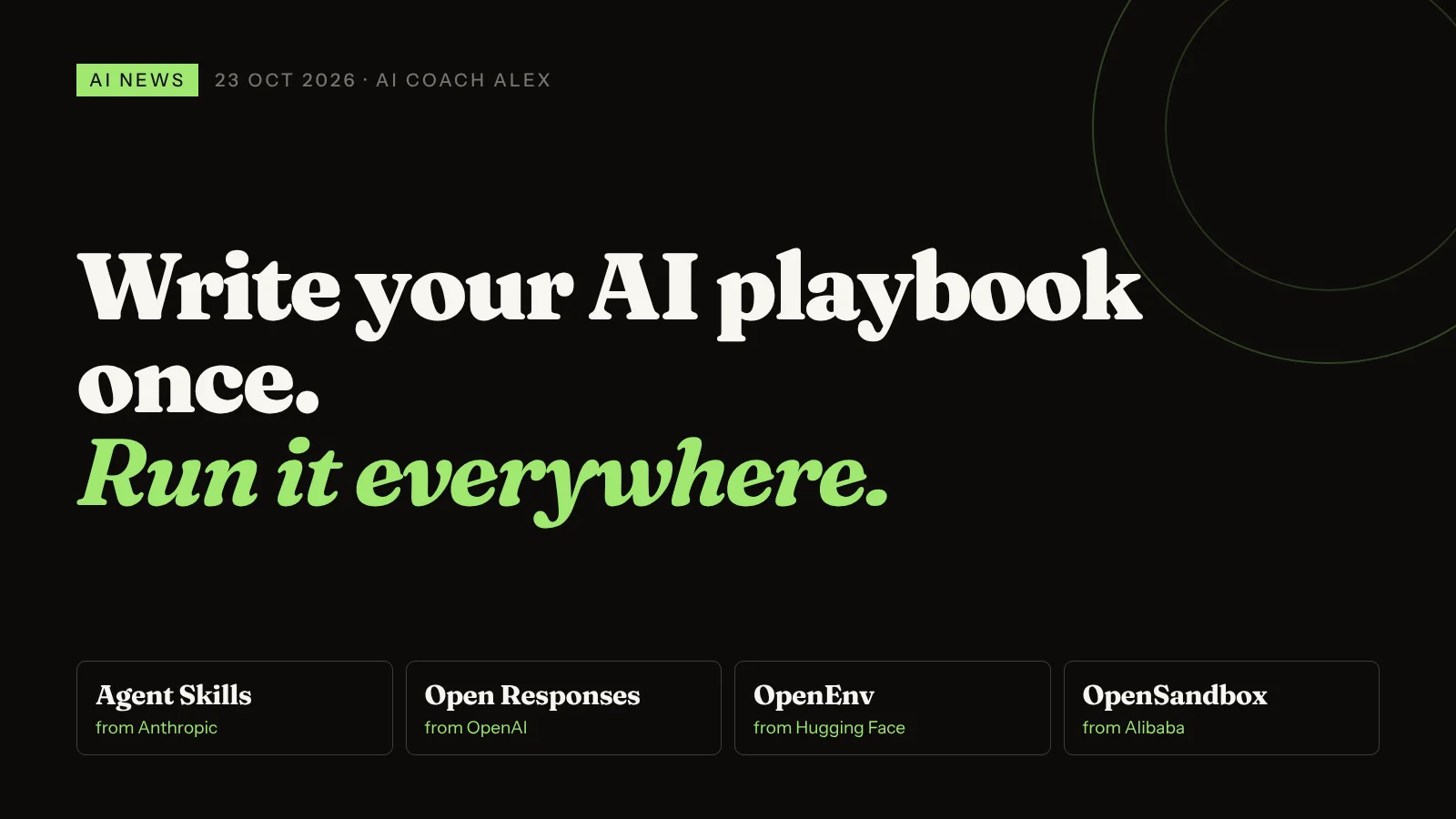
On 22 October 2026, Anthropic gave its Agent Skills format and OpenAI gave its Open Responses spec to the Agentic AI Foundation, a vendor-neutral body under the Linux Foundation. Agent Skills is the format for packaging how you want a task done (instructions, examples, files) so any AI agent can load it. Open Responses is a shared way of talking to AI models, so software can switch providers with few changes. For you, it means the time you invest teaching an AI your processes is no longer locked to one company. Start by turning your three most repeated tasks into skills.
Every few weeks someone in a lesson asks me a version of the same question: "What if I spend months setting up ChatGPT and my company moves to Claude?" Or Gemini. Or whatever wins next year.
It's a fair worry. Until now, the instructions, examples and templates you built for one AI tool mostly stayed in that tool. Yesterday, that got a lot less true.
What happened on 22 October?
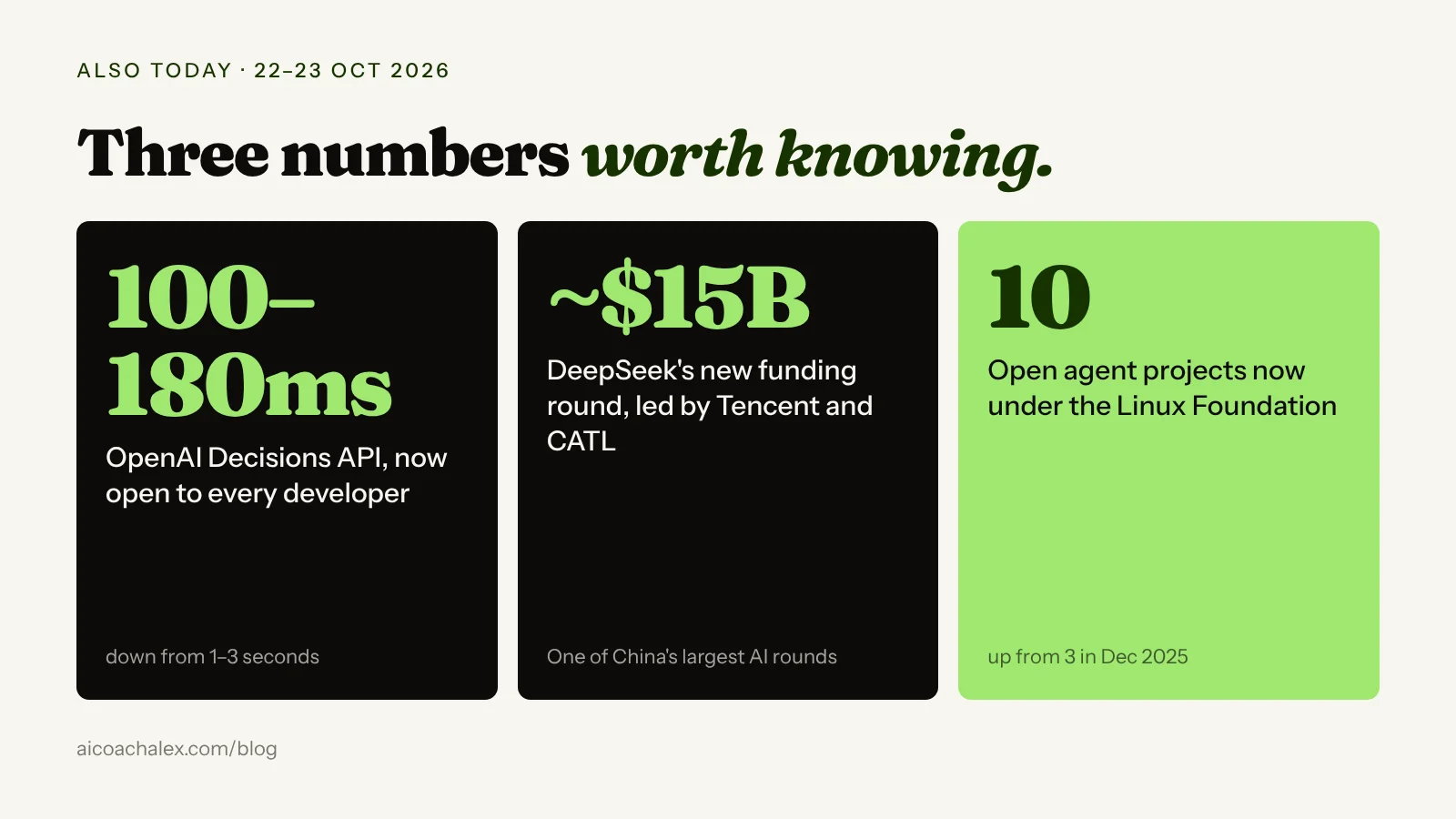
The Agentic AI Foundation (AAIF) announced four new projects at its AGNTCon + MCPCon conference in San Jose. AAIF is the Linux Foundation's neutral home for the open standards that AI agents run on. It already looks after MCP, the protocol that lets AI connect to your apps, and AGENTS.md. It started last December with three projects; it now has ten.
| Project | Donated by | What it is, in plain English |
|---|---|---|
| Agent Skills | Anthropic | A standard folder format for "how to do this task": instructions, examples and files an agent loads only when needed. |
| Open Responses | OpenAI | A shared way for software to talk to AI models, based on OpenAI's own API, so apps can switch provider with few changes. |
| OpenEnv | Hugging Face | Standard practice environments that AI labs use to train and test agents. |
| OpenSandbox | Alibaba | Safe, isolated "rooms" where agents can run code and use tools without touching your real systems. |
The last two matter mostly to the people building AI. The first two matter to anyone using it at work.
Two of the fiercest rivals in AI just agreed that the plumbing should belong to nobody. That's good news for everyone who isn't a plumber.
Why should a non-developer care?
Because your real AI asset isn't the subscription. It's the know-how you've taught it: how you write proposals, how your weekly report is structured, which checks you run before an invoice goes out. That know-how takes hours to get right.
- Less lock-in. A skill you write today in Claude can be loaded by Codex, Gemini CLI, Cursor, GitHub Copilot and 30+ other tools that already read the format. Now that it sits with a neutral foundation, no single company can change the rules on you.
- Easier switching. Open Responses means the apps and automations your company builds can swap the model underneath with little rework. If a cheaper or better model appears, moving is a setting, not a rebuild.
- Shareable expertise. A skill is just a folder. You can hand it to a colleague, a new hire or a client, and their AI does the task your way.
What exactly is an Agent Skill?
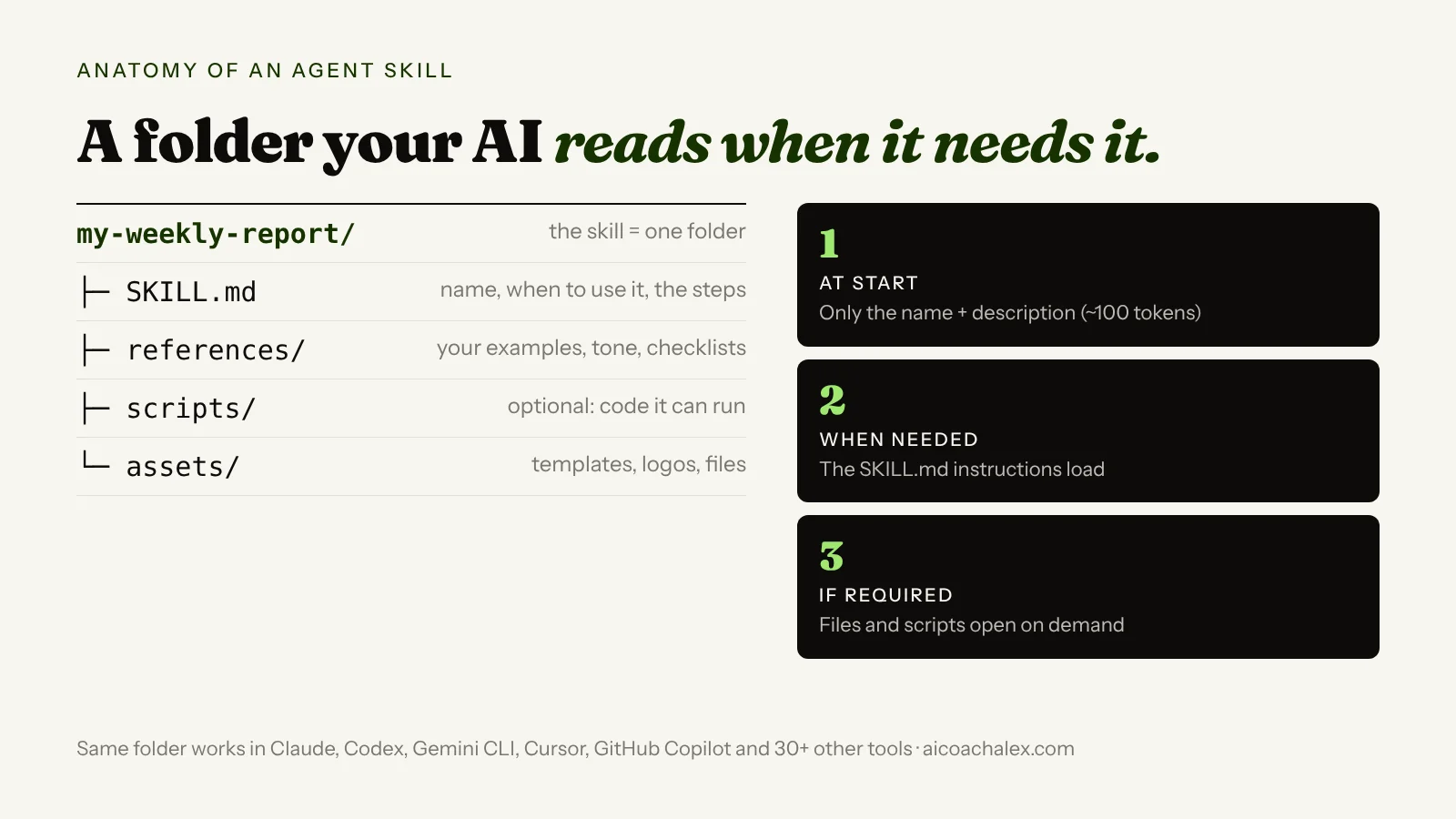
A skill is a folder with one required file, SKILL.md. At the top of that file sit a name and a one-line description of when to use it. Below that come the steps, in plain language. Optional sub-folders hold examples, templates or small scripts.
The clever part is how it loads. At the start of a conversation the AI sees only the name and description of each skill, roughly 100 tokens each. When your request matches, it reads the full instructions. Only if it needs them does it open the files. You can install dozens of skills without filling up the AI's memory.
How to take advantage of this, starting this week
- Pick three tasks you repeat every week. A weekly client update, a proposal, a meeting recap, social posts in your tone. Repetition is what makes a skill pay off.
- Write down how you do them. The steps, what good looks like, two real examples, the mistakes to avoid. This is the hard, valuable part, and it's yours.
- Turn each one into a SKILL.md with the prompt below. Save the folders somewhere you own, like a Google Drive or Dropbox folder, not only inside one AI app.
- Install them where you work. In Claude you can upload a skill from Settings; Claude Code, Codex and Gemini CLI read them from a skills folder. Then test the same skill in a second tool and compare.
- Share the winners with your team. A good skill is a process document that actually gets followed, because the AI follows it every time.
Copy this prompt: turn one of your processes into a skill
Paste this into Claude, ChatGPT or Gemini, then describe a task you do often.
You are helping me turn one of my recurring work tasks into an Agent Skill (the open SKILL.md format).

First, interview me. Ask me one question at a time, up to 8 questions, about:
- what the task is and when I do it
- the exact steps I follow
- what a great result looks like (ask me to paste 1-2 real examples)
- my tone, format and length preferences
- common mistakes to avoid
- any templates, checklists or files I use

Then write the complete SKILL.md file:
1. YAML frontmatter with:
   name: lowercase-with-hyphens (max 64 characters)
   description: one or two sentences saying what the skill does AND when to use it
2. A short "Goal" section
3. Numbered "Steps" in plain language
4. A "Quality check" list the AI must run before giving me the result
5. A "Mistakes to avoid" list
6. An "Examples" section (or tell me which examples to save in a references/ folder)

Keep the SKILL.md under 300 lines. Finally, tell me the folder name to use and which extra files to put next to it.

The task I want to turn into a skill:
[describe it here]
Re-explaining your report format in every new chat, in every new tool.
"Do my weekly client update." The AI finds your skill, follows your steps, checks its own work, in whichever tool you're using.
Also today in AI
OpenAI's Decisions API is now open to everyone
Also on 22 October, OpenAI opened its Decisions API to all customers. It's a "decision model": instead of writing text, it picks one answer from options you define (which team gets this ticket, is this lead hot or cold, approve or flag). OpenAI built it from its GPT-6 Luna model, and says responses dropped from 1–3 seconds to roughly 100–180 milliseconds. The language-learning app Speak cut the time between actions from 1.4 seconds to 0.13. It's OpenAI's answer to TypeSafe's Jev, which I explained in What is Jev?
How to use it: any step in your business that is really a multiple-choice question (tagging emails, routing enquiries, sorting invoices) no longer needs a slow, expensive chat model. If you use Make, n8n or Zapier, that step can now be near-instant and cheap. Test decision models on your own data before trusting any benchmark: they currently rank very differently depending on who measures.
DeepSeek raises about $15 billion
Chinese lab DeepSeek is raising around 100 billion yuan (about $15 billion), with Tencent and battery maker CATL among the biggest backers, according to Bloomberg. The target was raised twice along the way. The money goes to data centres and more open-source models, ahead of a possible IPO.
What it means for you: cheap, high-quality open models from China aren't going away, which keeps pressure on prices across the board. If you use them, check where your data is processed: running an open model through a European or US host is different from using a company's own app.
Want your first three skills built with you?
In a 49€ diagnostic call we pick the tasks that eat your week and turn the first one into a skill that works in the AI you already use, and the next one you'll switch to.
Book a 49€ diagnostic →FAQ
What are Agent Skills?
Agent Skills is an open format, created by Anthropic, for packaging instructions, examples, templates and scripts into a folder that an AI agent loads only when a task needs it. Each skill has a SKILL.md file with a name, a description of when to use it, and the steps to follow.
What did Anthropic and OpenAI announce on 22 October 2026?
Anthropic donated Agent Skills and OpenAI donated Open Responses to the Agentic AI Foundation, part of the Linux Foundation. Hugging Face added OpenEnv and Alibaba added OpenSandbox. The foundation now hosts ten open agent projects, including MCP and AGENTS.md.
Which AI tools support Agent Skills?
Claude and Claude Code, OpenAI Codex, Gemini CLI, Cursor, GitHub Copilot and more than 30 other tools read the SKILL.md format, so a skill written once can be reused across them.
What is Open Responses?
Open Responses is an open specification, based on OpenAI's Responses API, that defines one common way for software to send requests to AI models and receive answers. Apps built on it can switch between AI providers with few changes.
Do I need to code to create an Agent Skill?
No. A skill can be a single text file written in plain language. Scripts are optional. You can ask an AI to interview you about a task and write the SKILL.md for you.
What is OpenAI's Decisions API?
It is an OpenAI service that picks one answer from options you define, such as which team should handle a ticket, in roughly 100 to 180 milliseconds. It became available to all OpenAI customers on 22 October 2026 and competes with TypeSafe's Jev.
Teach your AI once. Keep the know-how forever.
One-to-one coaching for professionals and business owners: we map your work, build your skills and agents on your real tasks, and keep them portable across tools.
Book a 49€ diagnostic → Personal AI SetupSources: Agentic AI Foundation announcement (22 Oct 2026); SiliconANGLE on the four projects; overview of the SKILL.md format and adopting tools; TechCrunch on the Decisions API (22 Oct 2026); Bloomberg via Yahoo Finance on DeepSeek's round. Recommendations from my own coaching work.