

AI agents (ChatGPT, Claude, Gemini and shopping assistants acting for a person) now find, compare and increasingly book on behalf of customers. Big platforms like Amazon and Delta block them because agents skip the ads and upsells they live on. A small business has nothing like that to protect, so the smart move is the opposite: make your prices, rules and booking step easy for an agent to read and act on, and keep a human check at the payment step. Start by asking three AIs to find, price and book you, and fix whatever breaks.
One of my clients runs an events production company in Italy. About 420 events a year. No website. Every single client comes by word of mouth.
In our lessons we built an AI agent that turns his site-visit notes into a quote. It worked, until it reached discounts. It stopped and asked. Not because the AI was weak, but because his discount rules had never been written down. They lived in his head.
This week I listened to Greg Isenberg's episode "The 9 Stages of AI Agent Adoption" and realised that same problem is about to hit him from the other side. Soon the person planning a wedding won't search for an events company. Their AI will. And an AI can't recommend, price or book a business it can't read.
What did Greg Isenberg say about AI agents and businesses?
Greg runs The Startup Ideas Podcast and studies where new markets open up. His argument, in short: there's a quiet war between businesses and AI agents, and it will follow a path we've seen before.
He describes an agent as a customer with a credit card that reads your site instead of looking at it. It skips the homepage video, the banners and the pop-ups. It goes straight to product details, prices, delivery costs and return policies. You give it a goal, some rules and a limit ("check with me before spending more than $50"), and it does the legwork.
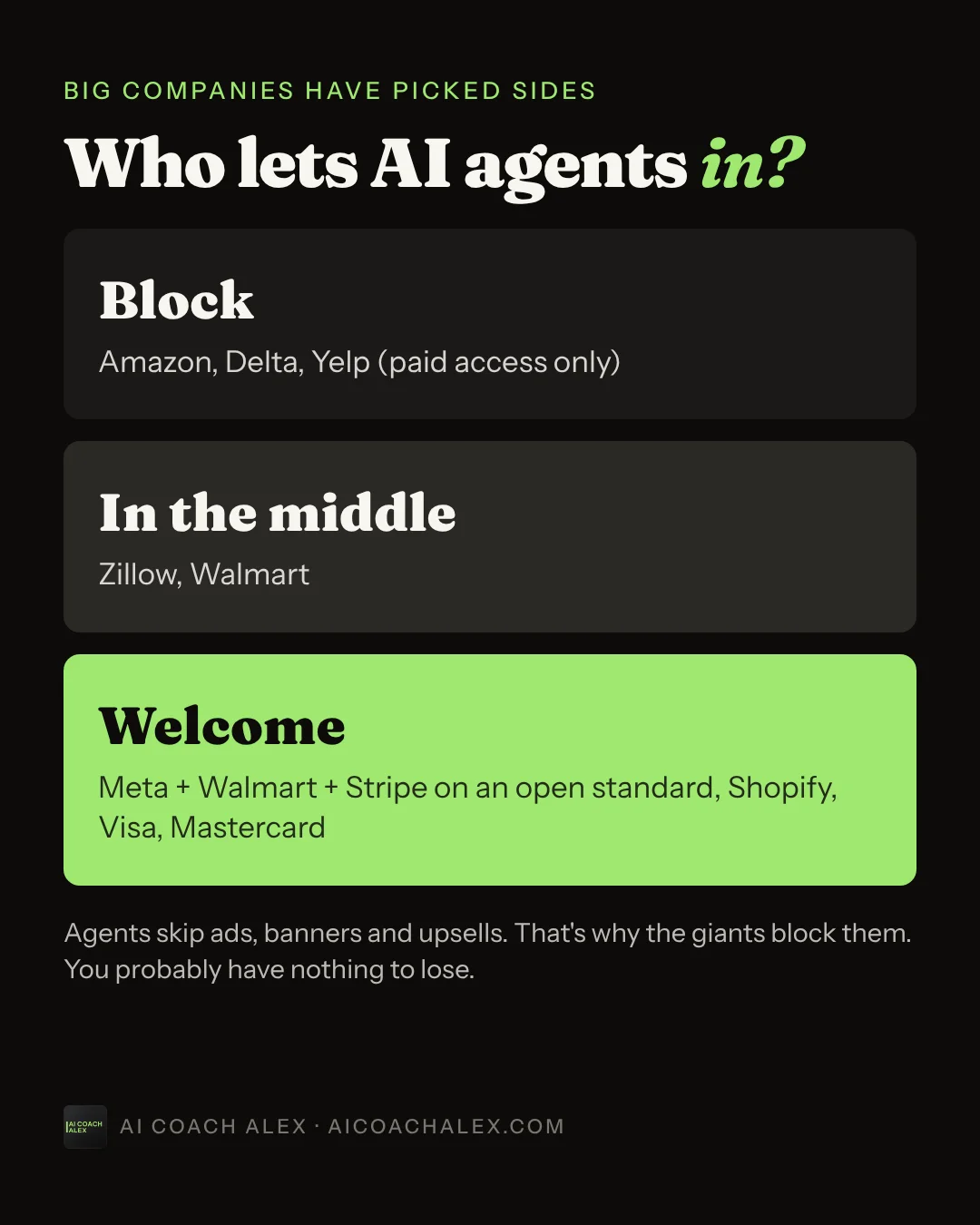
Big companies have already split into three camps:
- Blocking: Amazon has blocked Meta's shopping agent. Delta treats outside booking agents as unauthorised automated activity. Yelp only lets agents in through its paid data licensing.
- In the middle: Zillow says it welcomes agents acting for real customers, but its anti-scraping tools sometimes stop them anyway.
- Welcoming: Meta, Walmart and Stripe are working on an open standard. Shopify lets merchants sell through AI channels. Visa and Mastercard are building ways to recognise trusted agents.
Why block a customer who wants to buy? Partly real risk: an agent ordering 50 units instead of 5, or an airline needing proof that a passenger approved a booking. But mostly money. Agents don't see ads, seat upgrades or credit card offers. For Amazon and the airlines, that's billions in revenue that agents walk straight past.
Greg's prediction comes from banking. Banks fought Mint.com until Plaid built a proper, trusted connection between apps and banks. Then banks went from blocking, to signing deals, to charging for access. He expects agents to follow the same arc: blocking, an arms race, a split between who lets agents in and who charges, a "Plaid moment" for agent identity and payments, then businesses competing to win agents with faster checkouts and pages written for them. And eventually, ads return, as companies pay to be an agent's first recommendation.
What is the ladder of trust?

This is the most useful idea in the episode. An agent climbs three rungs:
- Research: it finds and compares options. Almost everyone allows this; it works like search.
- Prepare: it builds the basket or the quote. It needs real prices, rules and availability.
- Pay: it places the order or the booking. This is where the fight is.
Greg's point is that blocking all three rungs is a mistake. An agent can compare five suppliers in the time it takes you to open one tab, and it remembers what worked last time. A checkout it can't get through doesn't just lose one sale. It teaches the agent to go elsewhere.
Why is this good news for a small business?
Because you're not Amazon. You don't make your money from ads that agents skip. You make it when someone books you. Every agent that can read your prices and reach your booking step is a salesperson you don't pay.
The problem is that most small businesses I work with aren't readable at all. Their real information lives in:
- the owner's head (prices, discounts, what's possible on short notice);
- PDFs and images (price lists, menus, brochures);
- WhatsApp. An electrical contractor I coach in Sydney gets around 70% of his enquiries there, because customers find his personal number on Google Maps.
A human can work with that. An agent mostly can't.

After the episode, an events business owner in New York, Nicholas Rhodes, ran the test on his own company. He gave Claude, ChatGPT and Perplexity a realistic request: a company after-party in Manhattan for about 150 guests. None of the three found his business on their own. When he named it, all three rated it well. None quoted his real price; two made one up. None could book him.
The agents liked him. They just couldn't buy from him.
Want to run this test on your business with me?
In a 49€ diagnostic call we ask the AIs to find, price and book you, see where they get stuck, and list the fixes in order of impact.
Book a 49€ diagnostic →How do you make your business agent-ready? 5 moves for this week

- Run the agent test. Use the first prompt below in ChatGPT, Claude and Gemini. Ask as a customer would, without naming yourself. Write down: did it find you, did it get your price right, could it take the next step?
- Write your prices and rules down. Price ranges, minimums, what's included, discounts, lead times, the area you cover. This is the hard part, and it's the same work that makes your own AI assistant useful. My events client is doing it right now.
- Put the facts in plain text on one page. Not in an image, a PDF or an Instagram story. A simple "Services and prices" page with headings, numbers and your policies. The second prompt below drafts it for you.
- Give agents one clear next step. A booking link, a short quote form, or a WhatsApp link with a pre-filled message. If the only way to buy is "call us", the agent stops at rung one.
- Decide where a human steps in. For most small businesses: agents can research and prepare a quote; you approve before money moves, or you take a deposit through a link. Write that rule down too.
Prompt 1: the agent test
Act as my personal assistant. I need [the service you sell] in [your city or area] for [a realistic job: size, date, budget].

1. Find the 5 best providers. For each one give: name, website, why you chose it, and the price you expect for my job.
2. Tell me where each price comes from (a page on their site, a review, or your own estimate).
3. Pick your top choice and tell me exactly how you would book or request a quote from them right now, step by step.
4. Tell me what information you could NOT find that would have helped you decide.
Prompt 2: draft your agent-ready facts page
You are helping me write a "Services and prices" page for my business that both people and AI assistants can read and act on.

Interview me first, one question at a time (max 10 questions), about:
- what I sell and to whom
- price ranges, minimum orders, what's included and what costs extra
- discounts and when they apply
- the area I cover, lead times and availability
- how to book or get a quote, and what deposit or approval I need
- cancellations, refunds and guarantees

Then write the page in plain text with clear headings, real numbers (ranges are fine), short sentences and no marketing fluff. End with one clear "How to book" section. Finally, list anything I should decide or write down before publishing.
Is this an opportunity for AI consultants and freelancers?
Yes, and Greg says so directly. Among the startup ideas he lists are agent readiness (getting businesses ready for agent traffic), analytics for agent visits, and specialists who know how agents buy in one industry.
For a freelancer or consultant, the first one is a service you can sell next week, no software needed: run the agent test for local businesses in one sector, show them the result, and fix the page, the price list and the booking step. It's concrete, it's visual, and the before-and-after sells itself. If you want to build that kind of offer, it's exactly what we work on in AI for business owners.
The businesses that win the agent era won't be the biggest. They'll be the ones that wrote down how they work.
FAQ
What is an AI agent customer?
An AI assistant such as ChatGPT, Claude or Gemini acting for a person: it searches, compares options and can prepare or place an order or booking within limits the person sets. It reads your prices, details and policies rather than your design.
What is the ladder of trust for AI agents?
A framework from Greg Isenberg's podcast: agents move through three rungs, research, prepare and pay. Most companies allow research. The conflict is mainly at the pay rung, where companies decide whether an agent can complete a purchase.
Why do companies like Amazon block AI agents?
Partly for real risks such as wrong orders and proving the customer approved a purchase, but mostly because agents skip the ads, upsells and offers those companies earn from.
Should a small business block AI agents?
Usually not. A small business earns money when it gets booked, not from ads, so agents that can read its prices and reach its booking step are free salespeople. Keep a human approval or a deposit at the payment step.
How do I check if AI agents can find my business?
Ask ChatGPT, Claude and Gemini a realistic customer request for what you sell in your area, without naming your business. Check whether they find you, quote your real price and can take a booking or quote step.
What makes a website agent-ready?
Prices or price ranges, what's included, policies, area and availability written as plain text on a page, plus one clear way to book or request a quote. Avoid putting key facts only in images, PDFs or social posts.
Make your business easy for people and agents to buy from.
One-to-one coaching for business owners: we write down how you sell, build the page and the AI assistant that runs on it, and test it with real agents.
Book a 49€ diagnostic → AI for business ownersSources: Greg Isenberg, "The 9 Stages of AI Agent Adoption, Explained", The Startup Ideas Podcast, 21 Oct 2026 (also on YouTube): the three camps, the agent definition, the ladder of trust, the Mint/Plaid parallel, the stages and the startup ideas. Nicholas Rhodes, "AI Agents Can't Find Your Business. I Tested Mine.": the three-agent test. Client examples and the five moves are from my own coaching work.