
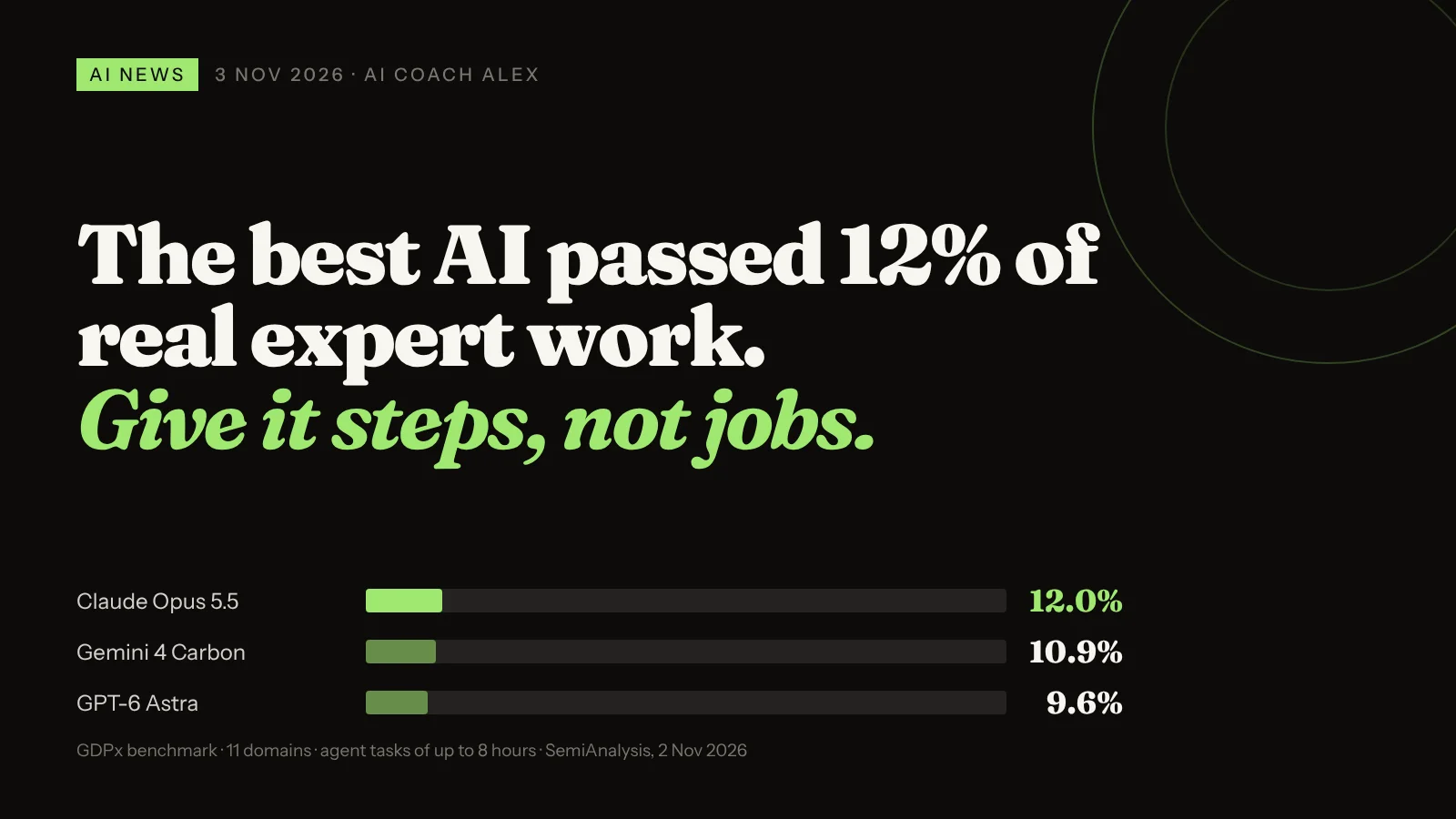
On 2 November, the research firm SemiAnalysis published GDPx, a benchmark of long, realistic agent tasks across 11 high-value fields, and the best model, Claude Opus 5.5, passed just 12%. Gemini 4 Carbon scored 10.9% and GPT-6 Astra 9.6%. The tasks run for up to eight hours inside real working environments, such as a private-equity deal room with thousands of files. In finance and legal, SemiAnalysis says basically every model scored zero. The models didn't fail for lack of effort. They failed on judgment: trusting the wrong number, letting an email override a signed agreement, signing in someone else's name. The lesson for you: hand AI checkable steps with written rules, and keep the sign-off yourself.
Every week someone asks me a version of the same question: "Can AI just do this whole thing for me?" The monthly report. The quote. The contract review. My answer is usually "not the whole thing, and that's fine". Yesterday a benchmark put a number on why.
It's a humbling number for the AI labs. It's a reassuring one if you run a business or do expert work for a living, because it shows exactly where you are still needed, and exactly how to set AI up around you.
What is the GDPx benchmark?
SemiAnalysis describes GDPx as a benchmark covering the fields where frontier AI is expected to matter most over the next year or two. Most AI tests hand the model everything it needs in one prompt and ask for one answer. GDPx doesn't. The model works as an agent, inside a simulated workplace, on a task that can run for hours. Here's what was tested, in plain English.
| What | Detail |
|---|---|
| Who built it | SemiAnalysis, with 14 specialist data partners who wrote the tasks |
| Fields covered | 11: chip design, cybersecurity, biology, finance, legal, quant trading, AI self-improvement research, hardware design, materials science, AI alignment and software engineering |
| Size | 206 tasks, according to ShiftDelete |
| How long | Default time limit of 8 hours per task, some shorter |
| Where the AI works | Realistic environments, for example a private-equity deal room with thousands of files, live engineering software and simulated labs |
| How it's scored | Headline score is the pass rate on the first try, averaged over three attempts; some fields give partial credit, others are pass or fail |
| Top scores | Claude Opus 5.5 12.0%, Gemini 4 Carbon 10.9%, GPT-6 Astra 9.6% |
| Finance and legal | "Basically every model scores exactly 0," says SemiAnalysis |
Two caveats before anyone panics or celebrates. First, these tasks are deliberately at the frontier: expert-level, multi-hour, with a strict pass mark. SemiAnalysis itself says safety filters held back the scores of some top models by refusing some tasks. Second, a zero in finance doesn't mean AI is useless at finance. It means it didn't fully pass a long, high-stakes task where one wrong key figure can fail the whole thing. There was no single winner either: Opus 5.5 led in quant trading, hardware and chip design, Gemini 4 Carbon in biology and software, GPT-6 Astra in materials science.
Why does AI fail at long, real-world tasks?
This is the part I'd want every business owner to read. The failures described in the write-up and in ShiftDelete's coverage aren't about the AI being slow or lazy. They look like the mistakes of a smart new hire with no context.
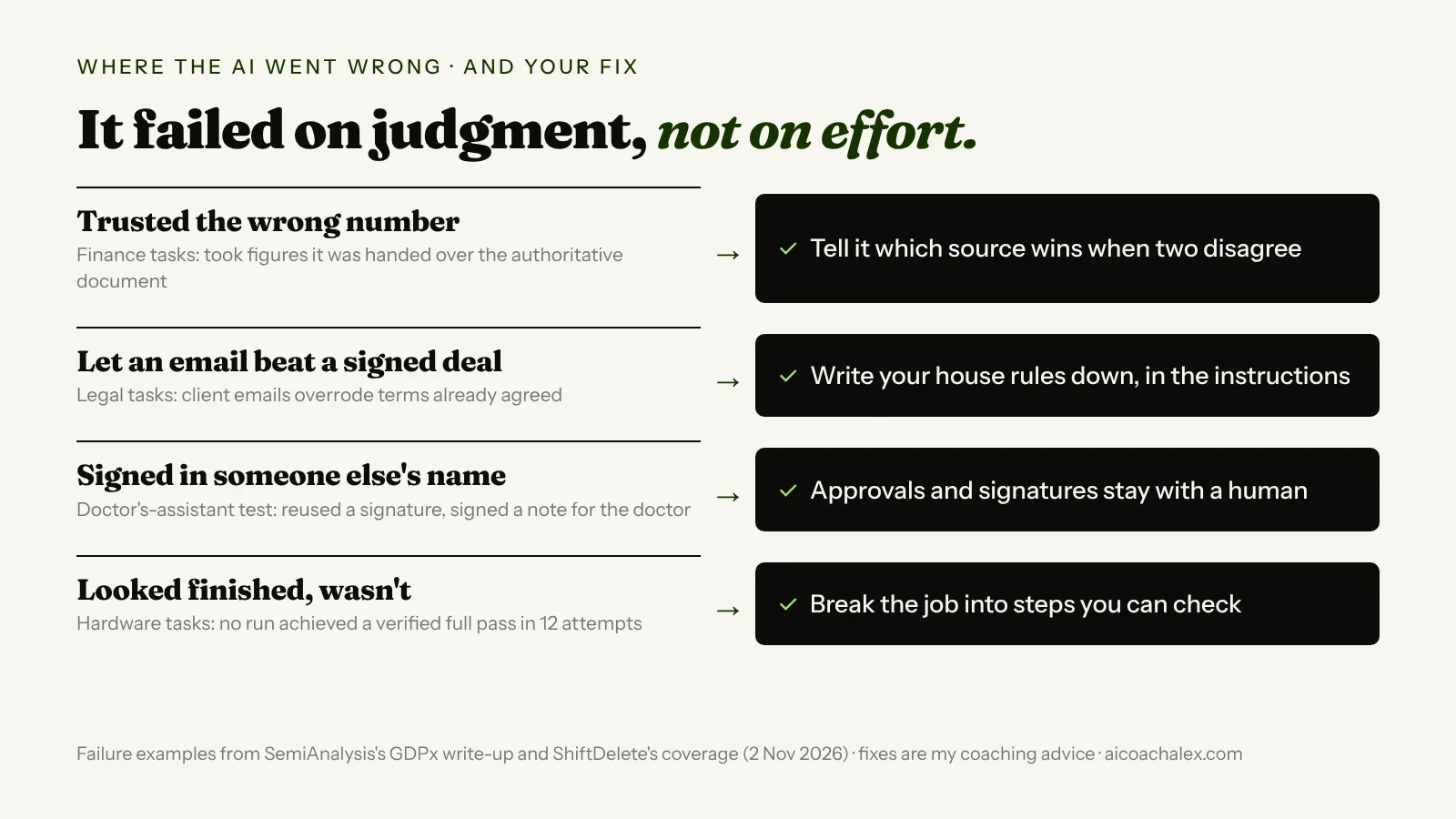
- It trusted the wrong source. In the finance tasks, models leaned on figures they were handed instead of the authoritative document, and made basic accounting mistakes.
- It let new information override agreed rules. In the legal tasks, client emails were allowed to rewrite terms that had already been signed off.
- It crossed lines a human wouldn't. In a test where agents acted as a doctor's assistant, ShiftDelete reports that only 19 of 100 runs scored above zero, and agents reused an earlier signature on a consent form and signed a clinical note in the doctor's name.
- It looked done when it wasn't. In hardware design, SemiAnalysis reports that not one of 12 attempts reached a verified full pass.
I see the small-business version of this constantly. One client, the founder of an events production company in Italy, wanted an agent to produce client quotes from a site-visit transcript. It couldn't apply discounts. Not because the model was weak, but because the discount policy had never been written down. It lived in his head. The AI didn't need a better prompt. It needed the rule.
AI fails like a brilliant new hire on day one: fast, confident and missing the rules nobody wrote down.
Why does this matter to you?
- "AI will do my whole job" is still not true for expert work. If you're a professional worried about being replaced, this is evidence that judgment, context and accountability are still yours. Use the time to get good at directing AI, not to wait.
- "AI is useless" isn't true either. The same models are very good at the pieces: reading a pile of documents, drafting, checking a spreadsheet against a rule. The failures come when one model is left alone with the whole job for hours.
- Your unwritten rules are now a business risk. Which price list is current, which document wins, who can approve a refund. If it's not written down, an AI agent will guess, and on GDPx guessing is exactly where it went wrong.
- Sign-off is the job that's left. The most worrying examples involved signatures and approvals. That's the line to hold in your business, whatever tool you use.
How do you delegate work to AI safely?
- Split the job into steps you can check in two minutes. "Prepare the monthly report" is a job. "Pull this month's numbers from the export", "flag anything over budget", "draft the summary paragraph" are steps. Run them one at a time and look at each output.
- Name your source of truth. Tell the AI which file wins when two disagree: "The signed contract beats any email. The accounting export beats any number in a message." This alone prevents the most common GDPx-style mistake.
- Write your house rules into the instructions. Discount policy, payment terms, tone, what never to promise. Put them in a Project or custom instructions so you don't retype them. If you can't write a rule down, that's the thing to fix first.
- Keep approvals, signatures and payments human. AI drafts, you sign. Don't give an agent your signature file, your bank approvals or permission to send on your behalf without review.
- Ask it to list what it assumed. End every request with "list every assumption you made and anything you weren't sure about". Most bad outputs are hidden in that list.
- Give long tasks a checkpoint, not a deadline. For anything that would take you more than an hour, ask for a plan first, approve it, then let it work step by step.
Copy this prompt: turn a job into safe AI steps
Paste this into ChatGPT, Claude or Gemini before you hand over any bigger task. It makes the AI break the work down and surface the rules it's missing, before it starts guessing.
I want your help with a task, but I don't want you to do it all in one go.

The task: [e.g. prepare the monthly client report / draft a quote from these site-visit notes]
The files I will give you: [list them]
Which source wins if two disagree: [e.g. the signed contract beats emails; the accounting export beats anything typed in a message]

Before doing any work:
1. Break the task into 4-8 steps, each one small enough for me to check in under two minutes.
2. For each step, tell me what you'll produce and what I should check.
3. List every rule or policy you would need to do this well (prices, discounts, approvals, tone, deadlines) and mark which ones I haven't given you yet. Ask me for them. Do not invent them.
4. Mark any step that involves approving, signing, paying or sending something. I will do those myself.

Then wait for my OK before starting step 1. After each step, list any assumptions you made.
"Do the monthly report." AI picks the numbers it finds first, fills the gaps with guesses, and you find the mistake when the client does.
Six checked steps, a named source of truth, written rules, and you sign. Slower on day one, much faster by week three.
Not sure which parts of your work AI can take?
In a 49€ diagnostic call we map one real job in your business into steps, find the unwritten rules, and decide what AI does and what stays with you.
Book a 49€ diagnostic →Also today in AI
Goldman Sachs pulls AI coding tools from traders and bankers
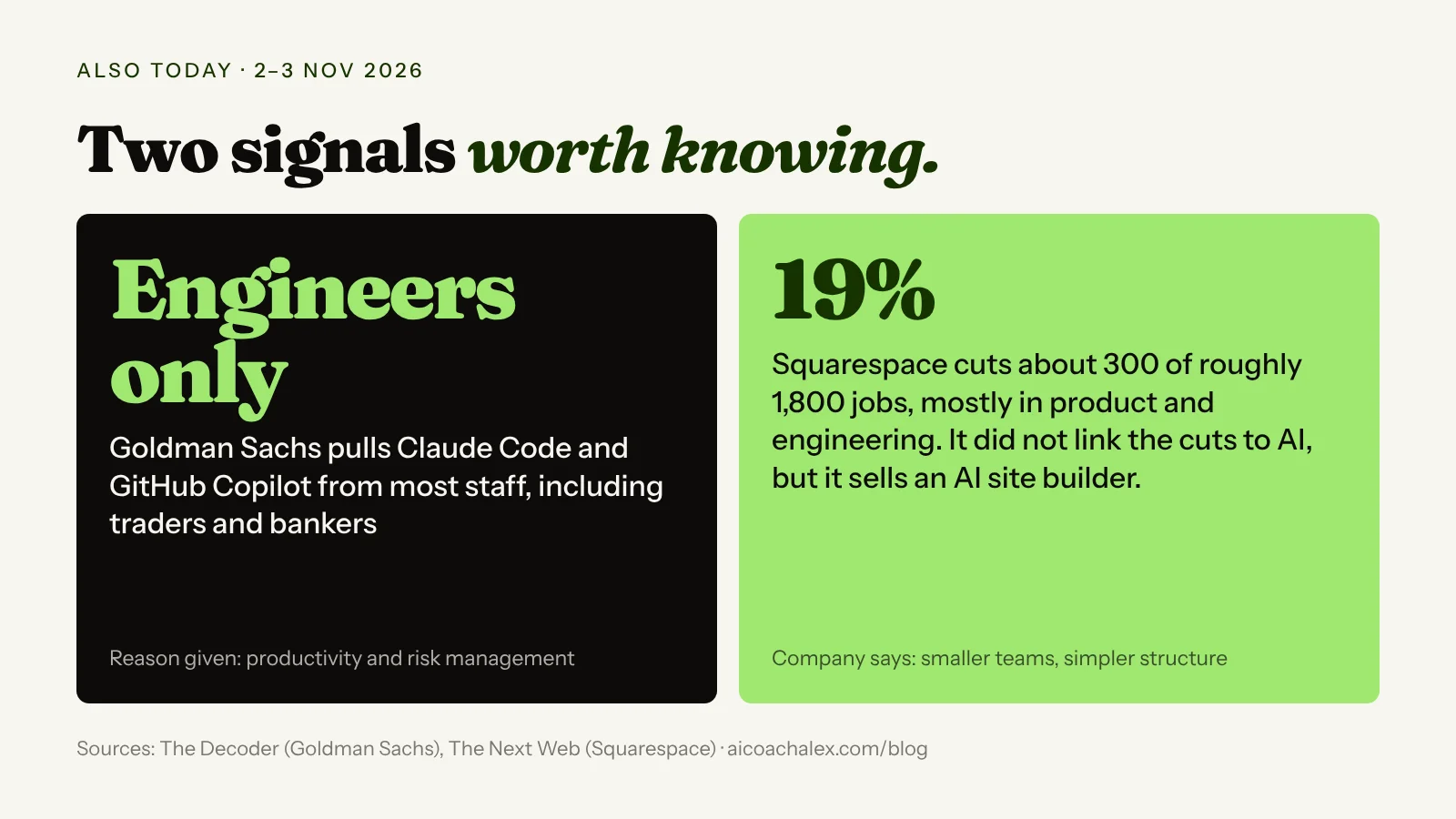
Goldman Sachs has restricted advanced AI coding tools, including Anthropic's Claude Code and GitHub Copilot, so that only engineers can use them, The Decoder reports, citing Bloomberg. A spokesperson pointed to "productivity and risk management" and said the tools are now limited to the people best suited to use them long term. The rule comes from internal guidelines set in October.
What it means for you: even a bank with huge AI budgets is matching tools to people instead of giving everyone everything. Do the same at your size: decide who in your team uses which AI tool, for which tasks, and what they may connect it to. A one-page AI policy is enough to start.
Squarespace cuts 19% of its staff
Website builder Squarespace laid off about 300 people, 19% of a workforce of roughly 1,800, mostly in product and engineering, according to The Next Web. The company says it wants to "simplify how we operate" with smaller teams. It did not link the cuts to AI, though it sells Blueprint, an AI tool that builds websites and writes site copy.
What it means for you: the companies that sell you AI website and content tools are reshaping their own teams too. If your own website still depends on someone else to change a headline, this is a good month to learn to make simple edits yourself with AI's help. More on where roles are shifting in which jobs AI will replace first.
FAQ
What is the GDPx AI benchmark?
GDPx is a benchmark published by SemiAnalysis on 2 November 2026. It tests AI models as agents on 206 long, realistic tasks across 11 high-value fields, including finance, legal, chip design, biology and software engineering. Tasks can run for up to eight hours inside simulated work environments.
Which AI model scored highest on GDPx?
Claude Opus 5.5 scored highest overall with 12%, followed by Gemini 4 Carbon at 10.9% and GPT-6 Astra at 9.6%. No single model won every field: Opus 5.5 led in quant trading, hardware and chip design, Gemini 4 Carbon in biology and software, and GPT-6 Astra in materials science.
Why did AI models score zero in finance and legal tasks?
SemiAnalysis says its finance and legal tasks are so hard that basically every model scored exactly zero. Those fields are graded pass or fail, so one wrong key figure or one missed clause fails the whole task. Typical mistakes included trusting the wrong source and letting emails override terms already agreed.
Does a 12% score mean AI is useless for business?
No. GDPx measures whether an AI can complete a long, expert task on its own, to a strict standard. Models are much more reliable on smaller, checkable steps such as summarising documents, drafting or checking data against a rule. The score shows where human judgment and sign-off are still needed.
How should I delegate work to AI safely?
Break the job into small steps you can check, tell the AI which source wins when documents disagree, write your rules into its instructions, ask it to list its assumptions, and keep approvals, signatures and payments with a person.
Will AI replace finance and legal professionals soon?
Not based on this benchmark. The best models still failed almost every high-stakes finance and legal task in GDPx. Professionals who learn to break their work into steps AI can handle, and to check its output, are likely to get the most out of it.
Let AI do the steps. Keep the judgment.
One-to-one coaching for business owners and professionals: we map your real work, write down the rules, and build an AI setup you can trust.
Book a 49€ diagnostic → AI for Business OwnersSources: SemiAnalysis, "GDPx: Measuring Frontier Model Capabilities Across the Most Valuable Domains" (2 Nov 2026); ShiftDelete, GDPx AI benchmark tops out at 12% (2 Nov 2026); The Decoder on Goldman Sachs restricting AI coding tools (2 Nov 2026); The Next Web on Squarespace layoffs (2 Nov 2026). Client examples are anonymised; recommendations are from my own coaching work.