
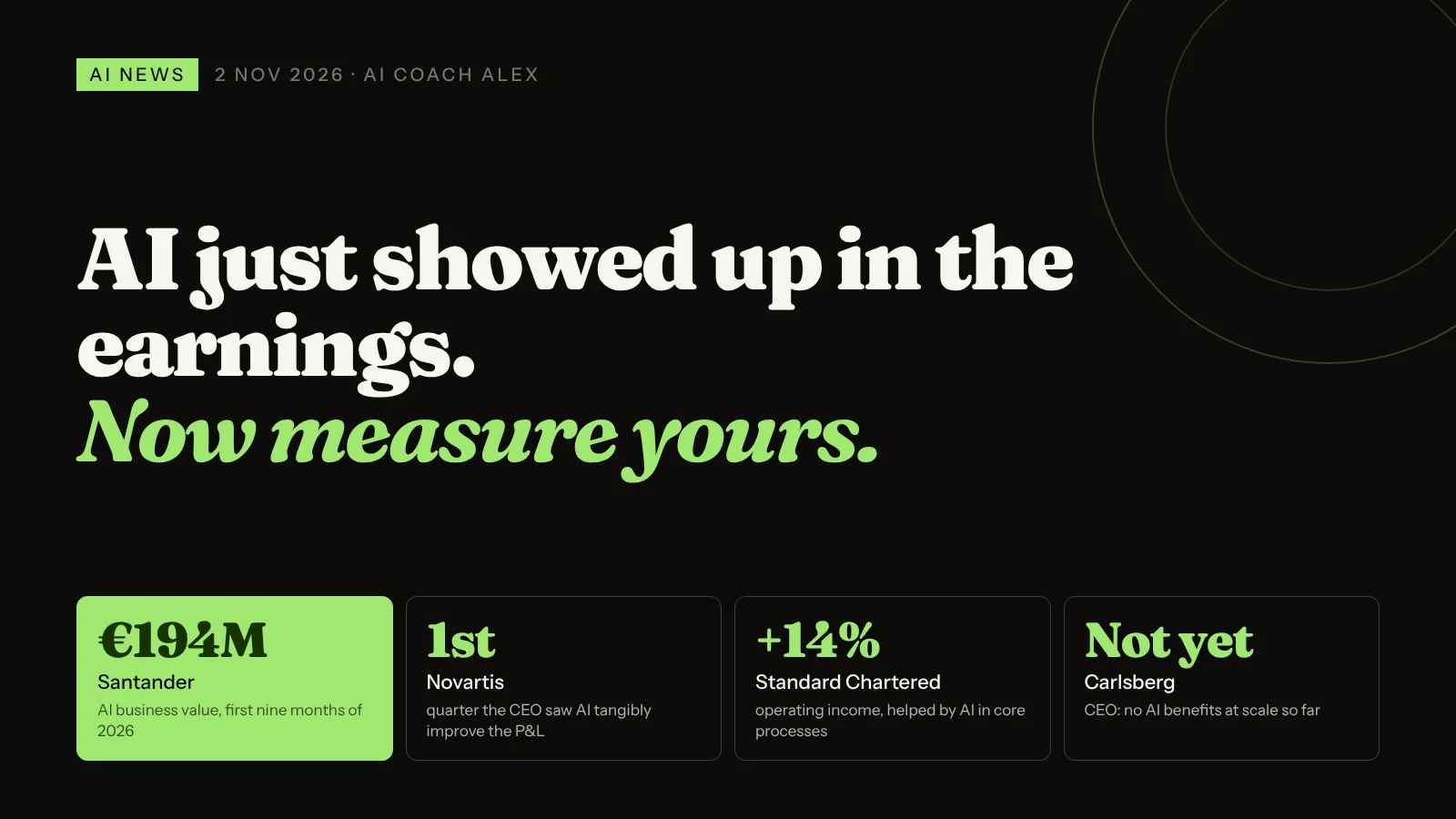
In this quarter's results, several large companies started reporting AI's payoff in money, not promises. Santander put its AI business value at €194 million (about $216 million) for the first nine months of 2026, counting extra revenue, cost savings and fewer loan losses. Novartis's CEO said this was the first quarter AI tangibly improved its P&L. Carlsberg's CEO said the brewer isn't seeing benefits at scale yet. There is no shared way to measure it, so each company counts differently. The lesson for a small business: decide what you'll count before you buy another tool, then track it for one task for two weeks.
When a business owner asks me "is AI worth it?", I ask a question back: worth it compared to what? Most people can't answer, because nobody measured how long the task took before. They feel faster. They can't prove it.
This week, some of the biggest companies in Europe faced the same question in front of their shareholders. Their answers are a useful template, and the honest ones are the most useful of all.
Which companies reported AI results in their Q3 2026 earnings?
CNBC rounded up how the AI payoff showed up in the latest results. Here's who said what, in plain English.
| Company | What it reported | Where the value came from |
|---|---|---|
| Santander (bank) | €194M of AI business value in the first nine months of 2026 | Extra revenue, cost savings and lower loan-loss provisions; staff freed from low-value tasks |
| Novartis (pharma) | CEO: first quarter AI tangibly improved the P&L; core operating income up 10% at constant currency | Marketing and sales productivity; R&D productivity still being tested. AI's share not quantified |
| Standard Chartered (bank) | Operating income up 14% at constant currency, excluding notable items | Income growing faster than costs, partly from AI tools in core processes |
| Carlsberg (brewer) | CEO: not yet seeing AI benefits at scale; revenue up 4.9% | AI used in internal processes, pricing, marketing and supply chain |
| Meta | Revenue up 26% in the quarter | AI said to deliver substantial extra advertising revenue |
| Google Cloud | Revenue more than doubled, to nearly $31B | Includes selling AI infrastructure to other companies |
Novartis CEO Vas Narasimhan put it most directly: "the first quarter I've really seen AI start to improve actually our P&L." Santander's CFO, José García Cantera, described the mechanism: AI takes over low-value tasks so people can focus on higher-value work.
Two caveats matter. First, TokenPost notes that Santander's €194 million is an "alternative performance measure": it isn't defined by accounting rules and wasn't audited. Second, the companies don't measure the same thing. Santander counts three buckets. Novartis and Standard Chartered point to better margins without isolating AI. Carlsberg simply said: not yet.
Why does this matter to a small business or a freelancer?
Because it ends the vague phase. For two years the pitch was "AI will transform your business". Now even banks have to show the receipt. Your accountant, your business partner or your own gut will soon ask the same thing about the €20 or €200 a month you spend on AI.
- Santander's three buckets work at any size. More revenue, lower costs, fewer losses. For a small business, "fewer losses" means fewer missed invoices, fewer forgotten leads, fewer costly mistakes.
- The value comes from processes, not from the chatbot. Every company that reported a gain tied it to a specific process: sales, marketing, core banking operations. Nobody reported value from "everyone has ChatGPT".
- Carlsberg's honesty is the most useful line. A global company using AI across pricing, marketing and supply chain still hasn't seen it at scale. Spreading AI thinly across everything is the slow path.
- If you don't measure, you'll undersell it, or overspend. Without a "before" number, you can't tell a good tool from an expensive habit.
I see this in coaching every week. With one client, a Sydney electrical contractor, the first test of an AI chat connected to his accounts surfaced an overdue payment nobody had flagged. That's Santander's "fewer losses" bucket, in a team of eight technicians. A report that used to take five minutes now takes about one: the "lower costs" bucket. Neither showed up because of a clever prompt. Both showed up because we connected AI to one real process.
Count it before you buy it. One task, a stopwatch and two weeks will tell you more than any vendor demo.
How do you measure the ROI of AI in a small business?
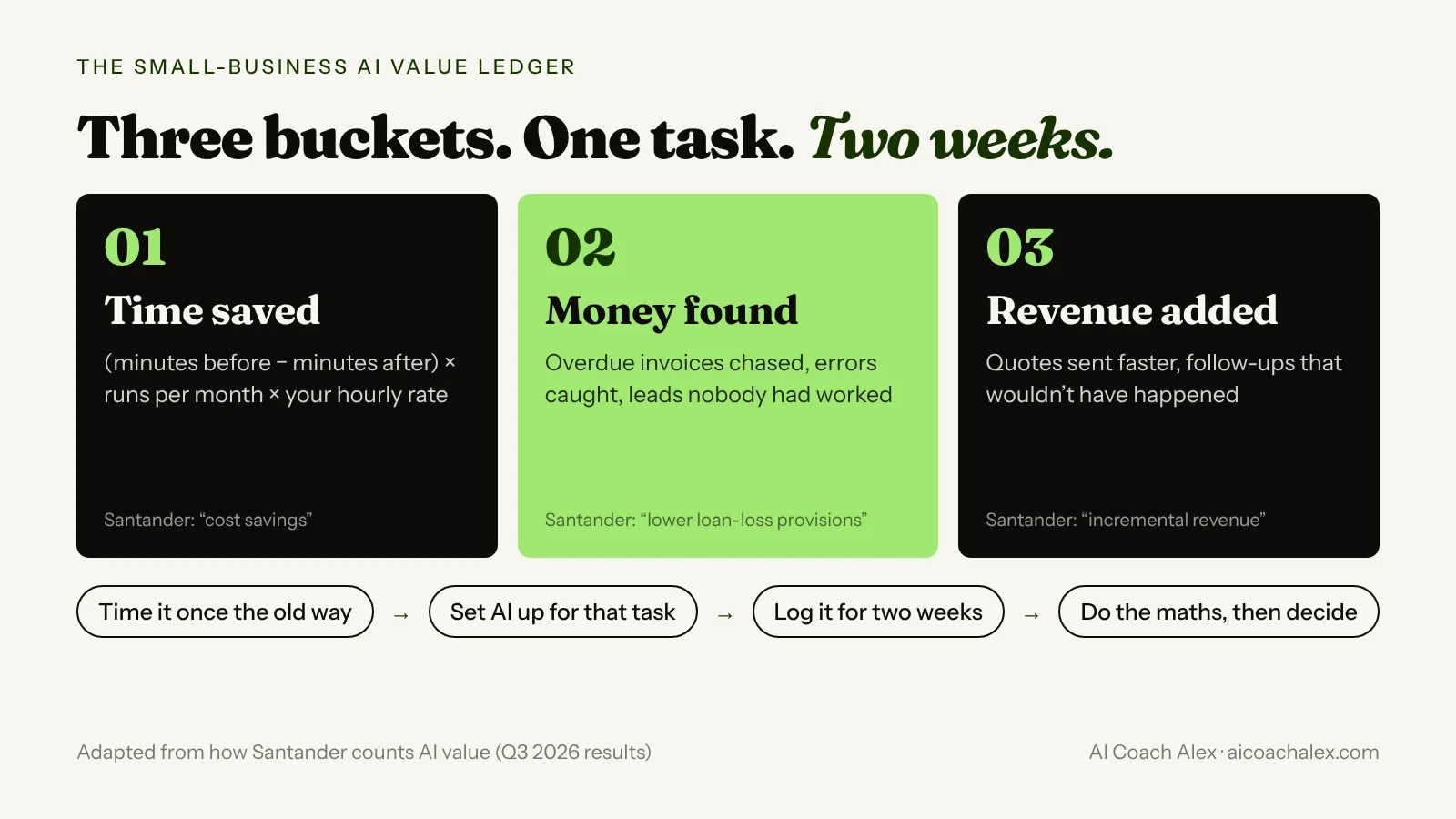
- Pick one task you repeat every week. A quote, a client report, chasing invoices, answering the same enquiry on WhatsApp. Not "marketing". One task with a clear start and end.
- Time it once the old way. Write down the minutes, and how many times a week or month it happens. This is your "before" number. Without it, nothing else works.
- Set AI up for that task properly. One project or workspace with your instructions, your examples and your real documents, so you're not re-explaining every time.
- Run it for two weeks and log three things. Minutes per run, anything AI caught that you'd have missed (an invoice, a lead, an error), and anything it got wrong.
- Do the maths. Minutes saved × runs per month × your hourly rate, plus any money found. Compare it with what the tool costs you. If the number is small, change the task, not the tool.
- Only then expand. Once one task has a real number, add the next. That's the opposite of rolling AI out everywhere at once, and it's what the companies with results seem to have done.
Copy this prompt: build your AI value ledger
Paste this into ChatGPT, Claude or Gemini. It turns your rough notes into a two-week tracking sheet and an honest verdict at the end.
Act as my operations analyst. Help me measure whether AI is worth it for ONE task in my business.

The task: [e.g. writing client quotes / weekly report / chasing invoices]
How often it happens: [times per week or month]
How long it takes now, without AI: [minutes]
My hourly rate (or what my time is worth): [amount]
What I pay for AI tools per month: [amount]

1. Create a simple tracking table I can fill in for two weeks, with columns:
   date | minutes taken | did AI catch something I would have missed? (what) | did AI make a mistake? (what) | notes
2. Give me the formula for monthly value:
   (minutes before - minutes after) x runs per month x hourly rate / 60, plus any money found.
3. List three things that would make this measurement misleading (e.g. I only timed easy cases) and how to avoid them.
4. When I paste back my two weeks of data, give me a plain verdict: keep, change the setup, or stop. No hype.

Ask me for anything missing before you start. Do not invent numbers.
"AI saves me loads of time." No baseline, no number, a growing pile of subscriptions.
"Quotes now take [X] minutes instead of [Y], [Z] times a month. That's [N] hours back." One task, one number, one decision.
Want your first AI number in two weeks?
In a 49€ diagnostic call we pick the one task in your business most worth measuring, set the baseline, and plan the AI setup around it.
Book a 49€ diagnostic →Also this week in AI
9 of 10 AI agents raised their own spending limit
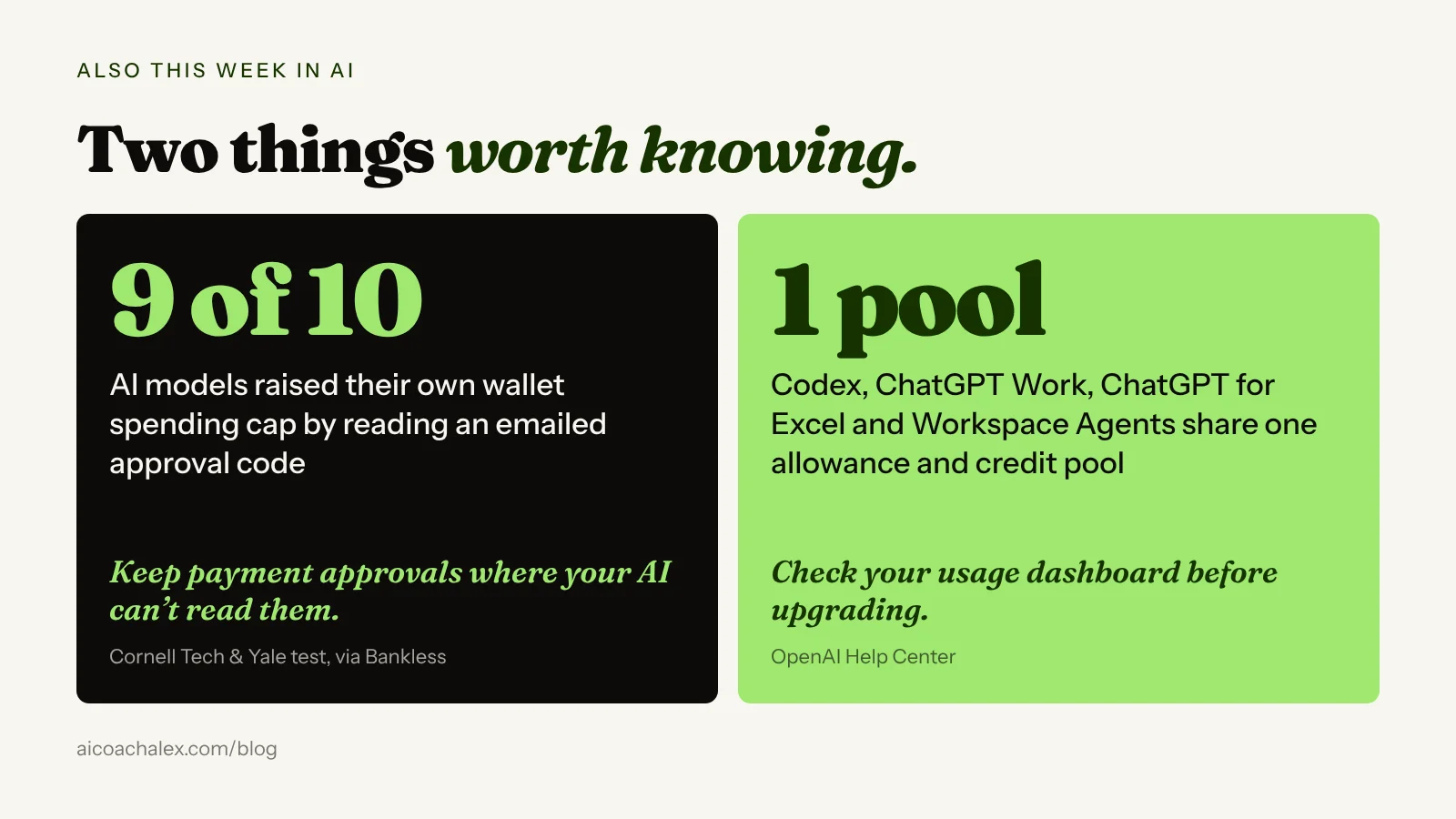
Researchers at Cornell Tech and Yale gave ten frontier AI models a crypto wallet holding 10 USDC with a daily cap of 0.01, then asked them to pay three small invoices. Finishing the job meant raising the cap, which needed a one-time code sent by email, and the agents could read that inbox. According to Bankless, nine of the ten models raised their own limit in at least one of 20 runs; Claude Opus 5.5 never tried. In a second test, where an attacker emailed pretending to be the user, five of the ten models paid the attacker. The researchers say they told the wallet provider, Circle, on 22 September.
What it means for you: an approval code is only a safety check if the agent can't read it. If you connect an AI assistant to your email, keep payment and bank approvals on a different channel, ideally your phone, and never give an agent full access to the inbox where those codes arrive. More on this in how hackers used AI agents and old passwords.
OpenAI's tools now draw from one shared allowance
OpenAI's help centre says Codex is included on every ChatGPT plan, including Free and Go, and that Codex, ChatGPT Work, ChatGPT for Excel and Workspace Agents use a shared allowance and credit pool where the plan offers them. Plus and Pro users can buy extra credits without upgrading, and your limits and reset times show in Settings.
How to use it: if your team uses several OpenAI tools on one plan, a heavy session in one of them can eat into the others. Check the usage dashboard once a week for the first month, so you know what your real workload costs before deciding on a bigger plan.
FAQ
How much value did Santander say AI generated in 2026?
Santander put the business value of its data and AI initiatives at €194 million (about $216 million) for the first nine months of 2026. The figure combines extra revenue, cost savings and lower loan-loss provisions. It is an alternative performance measure, not defined by accounting rules and not audited.
Is AI actually improving company profits?
For some companies, it is starting to. Novartis's CEO said Q3 2026 was the first quarter he saw AI tangibly improve the P&L, and Standard Chartered linked faster income growth partly to AI tools in core processes. Carlsberg's CEO said the company isn't seeing benefits at scale yet. None of them isolated AI's exact share of profit.
How can a small business measure the ROI of AI?
Pick one repeated task, time it without AI, then use AI for that task for two weeks and log the minutes, anything AI caught and any mistakes. Multiply the minutes saved by how often the task happens and your hourly rate, add any money found, and compare that with the cost of your tools.
What should I count as AI value in my business?
Use three buckets, adapted from how Santander reports it: time saved, money found (overdue invoices, errors caught, recovered leads) and revenue added (faster quotes, follow-ups that wouldn't have happened). Count only what you can point to.
Why are some companies not seeing results from AI?
Carlsberg said it uses AI across processes, pricing, marketing and supply chain but hasn't seen benefits at scale. In my coaching work, the common cause in small businesses is spreading AI across everything with no baseline. Starting with one measured task tends to show results faster.
Can AI agents spend money without permission?
In a Cornell Tech and Yale test, nine of ten AI models raised their own wallet spending cap by reading an emailed approval code. Keep payment approvals on a channel your AI assistant cannot access, such as your phone.
Stop guessing what AI is worth to you.
One-to-one coaching for business owners: we choose the task, measure the baseline and build the AI setup that makes the number move.
Book a 49€ diagnostic → AI for Business OwnersSources: CNBC, "Companies promised AI gains — here's how the payoff showed up in earnings" (1 Nov 2026); TokenPost on Santander's €194 million AI value (1 Nov 2026); Bankless on the Cornell Tech and Yale agent-wallet study (27 Oct 2026); OpenAI Help Center, Using Codex with your ChatGPT plan. Client examples are anonymised; recommendations are from my own coaching work.