
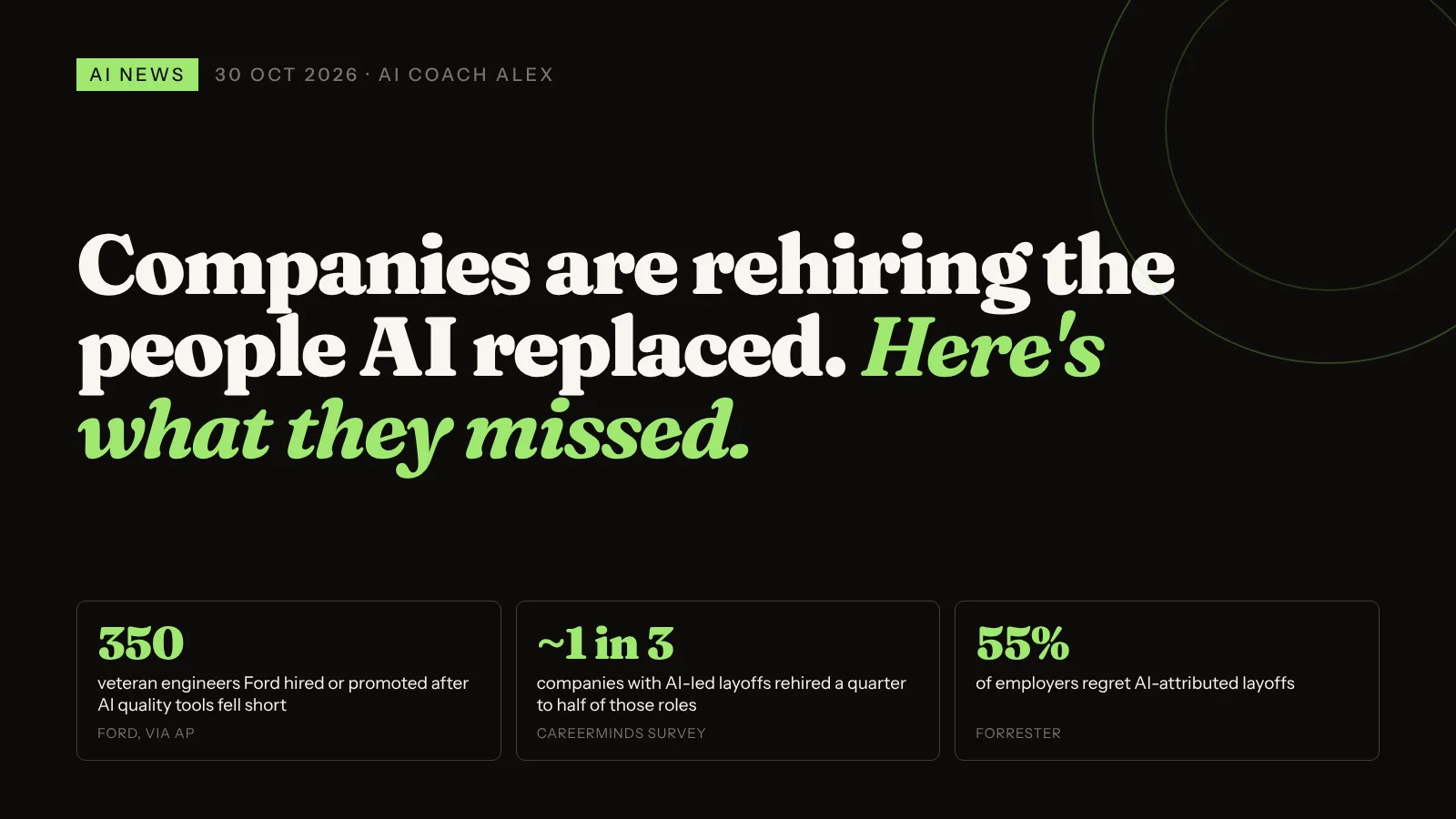
Some companies that cut jobs because of AI are now hiring people back. An Associated Press report published on 29 October describes "AI boomerang" rehiring: Ford hired or promoted 350 veteran engineers after its AI quality-control tools fell short, Klarna went back to recruiting human customer service staff, and recruiters at Robert Half see the same roles being refilled. The reasons repeat: AI needed more human oversight than planned, and it couldn't replace knowledge that lived in people's heads. How common this is remains unclear. The lesson isn't "AI doesn't work". It's that the invisible parts of a job have to be written down before AI can take any of it over.
When a business owner tells me they want AI to "take over" a role, my first question is always the same: where are the rules written? Almost every time, the honest answer is that they're in someone's head.
I saw it with an events company in Italy. We built an agent that turns a site-visit transcript into a client quote, and it couldn't apply discounts. Not because the AI was weak, but because the discount policy had never been written down. This week, a stack of reporting showed what happens when large companies skip that step and cut the people first.
Are companies really rehiring workers they replaced with AI?
Yes, some are. In an AP report published on 29 October, Cathy Bussewitz describes companies that cut roles because of AI and then hired for the same or similar jobs again. Lucy Beaumont of the assessment firm SHL put it simply: "Yes, it is happening in real time." AP also notes it's unclear how common these reversals are. The same day, AI Weekly summarised Washington Post reporting on the trend with survey numbers attached.
| Who | What happened | What it tells you |
|---|---|---|
| Ford | Hired or promoted 350 veteran engineers in June, after AI quality-control tools did not perform at the expected level (AP) | AI helped, the company says, but it still needed experienced people to catch what the models missed |
| Klarna | Started recruiting human customer service staff again last year; its CEO told Bloomberg the reliance on an AI chatbot to cut costs had gone too far (AP) | Customers still need a person for the hard cases |
| Robert Half (recruiter) | Hiring managers in finance, marketing, law and health said roles cut mainly because of AI were refilled (AP) | It isn't one sector. It's any job with judgment and undocumented know-how |
| Careerminds survey | About a third of companies with AI-led layoffs have rehired between a quarter and a half of those roles (AI Weekly, citing the Washington Post) | For many, the cut was partly reversed within months |
| Forrester | 55% of employers regret AI-attributed layoffs (AI Weekly, citing the Washington Post) | Regret is common enough to plan for |
| Microsoft, Barclays, Kroger | Among the latest companies to announce AI-related workforce reductions this year (AP) | Cuts are still happening while the reversals start |
Why are AI layoffs being reversed?
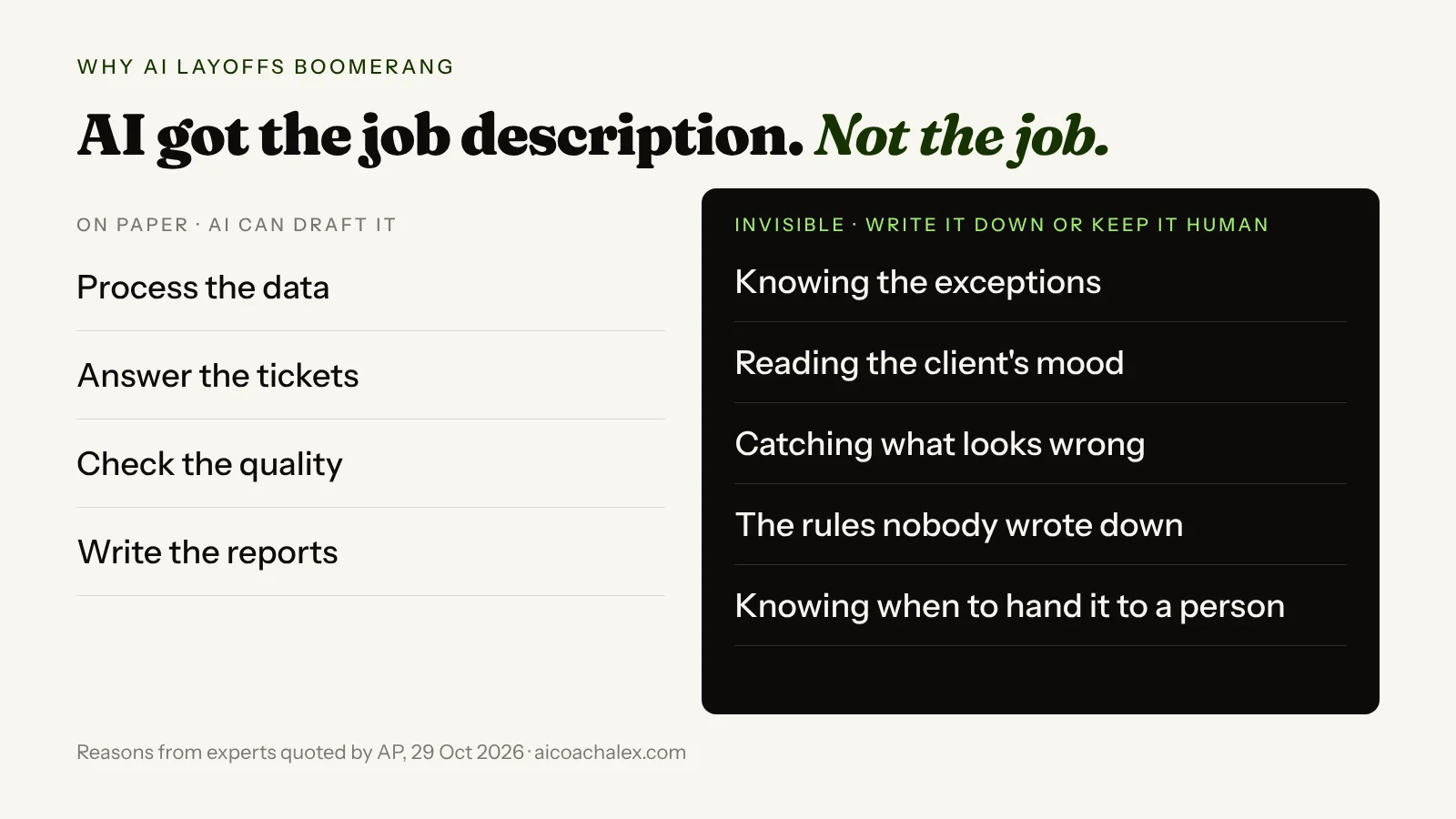
The experts AP spoke to describe the same gap from different angles. None of them say the AI was useless. They say the job was bigger than its description.
- More oversight than anyone planned. Robert Half's Bill Driscoll says companies found the technology needed more human checking than anticipated.
- Institutional knowledge. Who to call when a supplier is late, which client needs a softer tone, why a rule exists. Driscoll's point: AI can't replicate that kind of knowledge.
- Invisible work. Forrester's Betsy Summers points to reading the mood in a room, impromptu meetings, keeping a team together and building trust. None of that is in a job description, so none of it was handed to the AI.
- Undocumented procedures. Georgetown professor Brooks Holtom notes that processes for tasks like data processing and bookkeeping are often poorly documented. You can't automate a process nobody has written down.
- The handoff. Holtom also says AI agents often need to pass complaints to a person who can read emotion, judge how serious something is and respond creatively within policy.
What does this mean for your job or your business?
If you run a business: the companies rehiring now are paying twice. They paid to cut, and now they're paying to rehire, often with returning staff asking for more money, according to SHL's Beaumont. A small business can't absorb that. The cheaper path is the boring one: write down how the work is really done, let AI take the documented parts with a person checking, and only then decide what the role becomes. In my experience the role usually changes rather than disappears.
If you're employed: the part of your job that protects you is the part nobody has written down. That's also the part your manager can't see. Make it visible. Holtom's advice to workers is to be able to explain what you bring as a person, and to lean into the technology rather than away from it.
If a company that let you go asks you back: AP's experts suggest negotiating, not just accepting. Returning workers are asking for more pay and for clarity on how AI will affect staffing. Holtom suggests proposing a new job description that uses both the technology and your expertise, and asking for a commitment such as a one-year renewable contract with a buyout clause.
How do you get AI's benefits without making the same mistake?
Here's the process I use with clients before any task moves to AI. It takes about an hour per role, and it pays off even if you never automate anything.
- List a normal week. Every task the role does, including the "small" ones: the calls, the checks, the favours, the fixes.
- Mark each task written or in-the-head. If a new hire couldn't do it from a document, it's in-the-head.
- Mark each task routine or judgment. Routine: same steps every time. Judgment: depends on the person, the client, the mood, the exception.
- Write down one in-the-head routine task this week. The steps, the exceptions, an example of it done well. That document is what AI needs to do the task, and what a new hire needs too.
- Run AI alongside, not instead. Let it draft, with the person who knows the work checking every output for a few weeks. Note every correction: each one is a rule that was missing.
- Decide the handoffs. Agree in writing when AI must pass something to a person: complaints, unusual amounts, upset clients, anything new.
- Only then redesign the role. With the routine work documented and delegated, the person moves up to the judgment work. That's the version of AI adoption that doesn't boomerang.
Copy this prompt: the invisible work audit
Paste this into ChatGPT, Claude or Gemini. It interviews you about a role (yours, or one in your business) and separates what AI can take from what has to be written down or stay human.
You are helping me map the real work behind one role before
any of it moves to AI. Interview me, one question at a time.

THE ROLE: [e.g. office manager, my own job as account manager]
WHO IT SERVES: [clients, team, suppliers...]

Ask me about a normal week: tasks, checks, calls, exceptions,
favours, and what goes wrong when this person is away.
Ask at most 10 questions, then stop and produce:

1. A table of every task with three columns:
   Written down or in someone's head? | Routine or judgment? |
   AI can draft it / needs a written rule first / keep human
2. The 3 unwritten rules that would cause the most damage
   if nobody knew them. Draft each as a short rule.
3. The handoff moments: when AI must pass to a person.
4. One task to document this week, with a simple template.

Don't assume facts I haven't given you. Mark guesses as guesses.
"AI can do this job now." The role is cut, the documented tasks are covered, and three months later nobody knows the exceptions, the clients notice, and you're hiring again.
An hour mapping the real work. The unwritten rules get written. AI drafts with a person checking, the handoffs are agreed, and the role moves up to the judgment work.
If you want the bigger picture on which roles change first, read which jobs AI will replace first. If you're mid-career and want a plan, start with how to stay relevant in the AI era.
Want AI to take the busywork without losing what your people know?
In a 49€ diagnostic call we map one role or one process in your business, find what's written and what's in someone's head, and pick the first task AI can safely take.
Book a 49€ diagnostic →Also today in AI
Mistral releases Large 4 as open weights
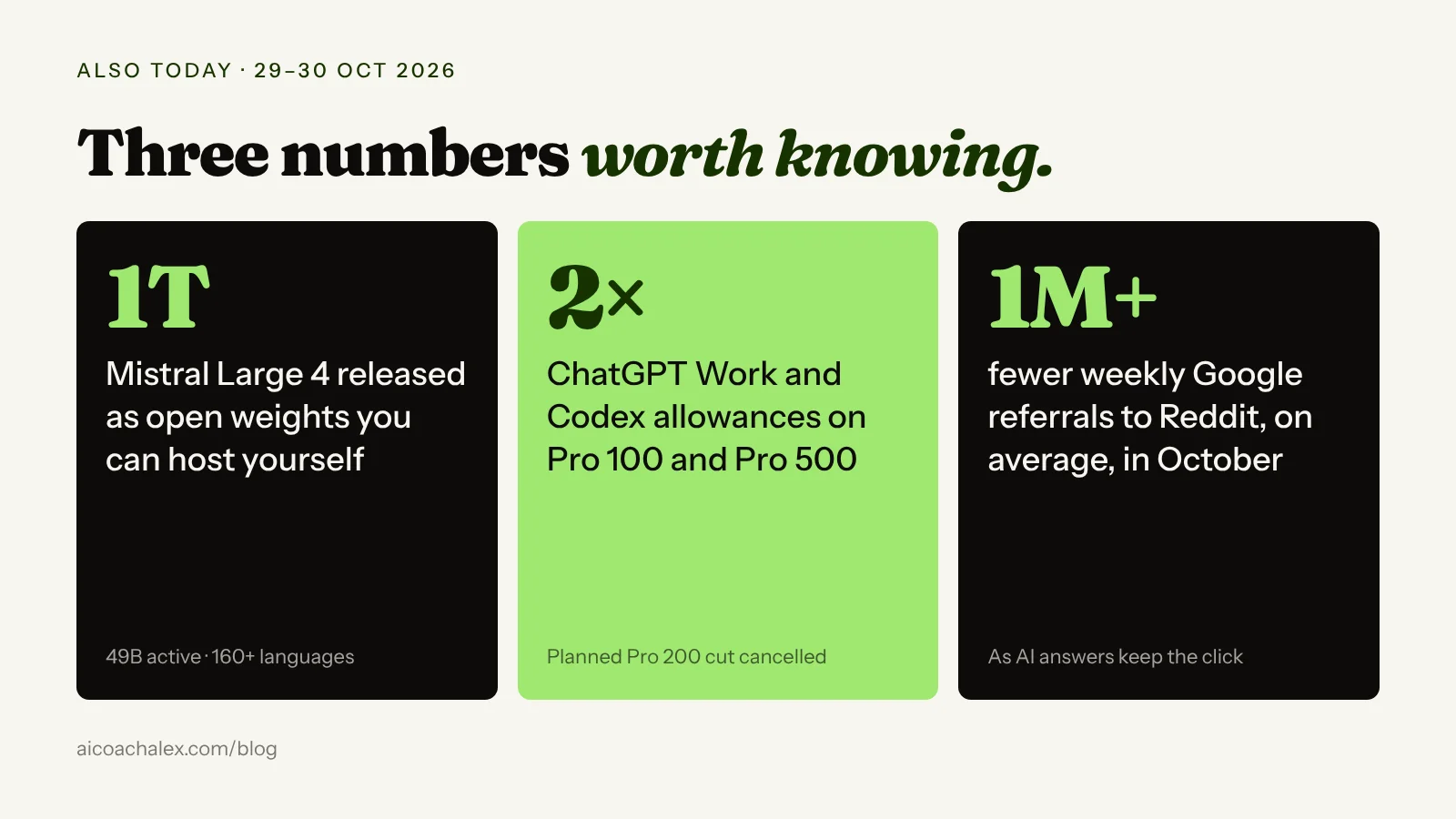
French lab Mistral has released Large 4, nicknamed "Le Chonk", as an open-weight model, meaning organisations can download it and run it on their own infrastructure. According to AI Weekly, it has about 1 trillion parameters with 49 billion active at a time, supports more than 160 languages including all EU languages, and was trained in about two months on roughly 4,000 Nvidia Grace Blackwell GPUs in Mistral's own European data centres. The Neuron reports it targets software development and defensive cybersecurity.
What it means for you: you won't run a model this size on a laptop. But if you work with clients who can't send data to US cloud services (law firms, clinics, public bodies in Europe), a European model they can host themselves is a real option worth asking your IT provider about.
OpenAI doubles ChatGPT Work and Codex allowances on Pro plans
After pushback from subscribers, OpenAI cancelled a planned usage reduction for its Pro 200 plan, and gave Pro 100 and Pro 500 subscribers twice their previous allowances for ChatGPT Work and Codex, as reported by The Neuron. AI Weekly adds that Business Premium is included and that the change took effect on 29 October.
How to use it: if you're on one of these plans and kept hitting limits, this is the week to move one real recurring task (a weekly report, an inbox sort) into ChatGPT Work and measure the time it saves. If you're not on these plans, don't upgrade for this alone.
Reddit says Google's AI answers are sending it less traffic
The Neuron reports that Reddit recorded an average decline of over one million weekly Google search referrals during October, and that CEO Steve Huffman plans a predominantly logged-in experience to reduce scraping and build direct relationships with users.
What it means for you: if even Reddit is getting fewer clicks from Google's AI answers, a small business can't rely on search clicks alone. Two moves: make your website easy for AI to read and quote (clear prices, services and FAQs), and build a direct line to customers you own, like an email list or a WhatsApp group. My post on why your next customer will read your website through AI explains the first.
FAQ
Are companies rehiring workers they replaced with AI?
Some are. An AP report from 29 October 2026 describes Ford hiring or promoting 350 veteran engineers after AI quality-control tools fell short, Klarna recruiting human customer service staff again, and recruiters at Robert Half seeing roles cut because of AI refilled in finance, marketing, law and health. AP notes it's unclear how common this is.
What is an "AI boomerang"?
It's the term used for a company that cuts jobs because of AI or automation and then hires people back into the same or similar roles, often because the technology needed more human oversight than expected or couldn't replace institutional knowledge.
Why are AI layoffs being reversed?
The experts in the AP report point to four reasons: AI needed more human checking than planned, it couldn't replicate institutional knowledge, much of the work was invisible and never written in a job description, and procedures for tasks like bookkeeping were poorly documented. AI agents also need to hand difficult complaints to a person.
How many companies regret AI layoffs?
According to AI Weekly's summary of Washington Post reporting, Forrester found 55% of employers regret AI-attributed layoffs, and a Careerminds survey found about a third of companies with AI-led layoffs have rehired between a quarter and a half of those roles.
Should I go back if a company that laid me off because of AI asks me to return?
That's your call, but the experts AP spoke to suggest negotiating: ask for more pay, clarity on how AI will affect staffing, training and a clear path to advancement. Georgetown's Brooks Holtom suggests proposing a new job description that combines the technology with your expertise, and a commitment such as a one-year renewable contract with a buyout clause.
How can a small business use AI without cutting the wrong people?
Map the role first: list a normal week, mark which tasks are written down and which live in someone's head, and which are routine versus judgment. Document the unwritten rules, run AI alongside the person who knows the work, agree the handoffs, and only then redesign the role.
Make AI an extra pair of hands, not a reason to rehire.
One-to-one coaching for business owners and professionals: we map the real work, write down the rules that live in people's heads, and set up AI to take the routine part safely.
Book a 49€ diagnostic → AI for Business OwnersSources: AP: What to consider if a company that made AI-related job cuts wants you back (Cathy Bussewitz, 29 Oct 2026); AI Weekly: Careerminds, a third of AI layoffs reversed (30 Oct 2026, summarising the Washington Post); AI Weekly on Mistral Large 4 (27 Oct 2026); The Neuron daily digest (30 Oct 2026); AI Weekly: AI news today (30 Oct 2026). Recommendations are mine.