

Most small businesses don't have an AI problem. They have a leak: people who already found them, often through paid ads, and then didn't call or book. In an audit of five well-reviewed plumbers in Dallas, four landing pages didn't repeat the ad's promise, three hid their Google rating and four made visitors scroll past three screens to book. Fix that first, measure booked jobs, then use AI for the follow-up and the reporting. If you sell AI services, lead with the leak and the money, not the technology.
When I moved my coaching off a marketplace and onto my own website, I spent weeks on the words. Who I help, how a lesson works, what people get out of it. I rewrote the headline more times than I'd like to admit.
What I didn't build was the step after the words. For a while, my landing page had no calendar and no way to pay. Someone who was ready to start had to write to me, wait for an answer, and agree a time by message. I had moved off the marketplace partly because it blocks links in messages. Then I built a site with no link to click either.
I can't tell you how many people left at that point. That's the thing about a leak. You don't see the people who walk out. You just see fewer people coming in, and you assume you need more traffic, a better headline, or some clever AI tool.
Today the page has a booking link and a 49€ diagnostic. It's not clever at all. It's a door.
I thought about that a lot this week while listening to "How to Sell AI to Main Street" on Greg Isenberg's Startup Ideas Podcast.
What does "selling AI to Main Street" actually mean?
Greg's guest was James Dickerson, known online as the Boring Marketer. He owns a mobile diesel repair business in North Carolina and has run marketing agencies for local businesses. Greg's framing: a lot of people are selling AI to other tech people, while the bigger opportunity is the plumbers, HVAC companies and trades that run the real economy.
James is specific about who. He looks for trades businesses doing roughly $2M to $20M a year, with high-ticket jobs, that already pay for leads. In plumbing and HVAC alone he counts about 112,000 companies averaging around $2.5M in revenue, and cites a figure that only 14% of owners say AI is fully part of their operations.
But the part that stuck with me wasn't the market size. It was what he sells. He doesn't sell AI. He sells booked jobs and phone calls. In his words, owners "care about revenue. They care about ROI." He even mentions testing AI voice receptionists and getting hang-ups from callers who wanted a human. So he never leads with "let me implement AI for you."
Where do small businesses lose customers?

To show the method, James pulled five plumbers in Dallas. These weren't bad businesses. They were rated 4.8 to 4.9 on Google, they were sizable, and all five were paying for Google ads. Then he looked at what happens after the click:
- 4 out of 5 landing pages didn't repeat the promise the ad had just made.
- 3 out of 5 didn't show their Google rating on the page, even though it was excellent.
- 4 out of 5 made visitors scroll past three screens before they could book.
The ads were working. The customer clicked. Then the page made them work for it, and some of them gave up. That's a leak: money you've already spent to get attention, lost in the last metre.
I see the same pattern in my coaching, just in different places. The leak might be a website, an Instagram bio with no link, a phone that rings out on a job site, a quote that takes four days, or a WhatsApp message that sits unread until Monday. Almost nobody I coach measures it, because nobody sends you a report of the customers you didn't get.
How much is a leak costing you?

This is where James's approach gets useful for owners, not just for agencies. He doesn't argue about design. He does the math with the owner's own kind of numbers.
His example: 100 leads a month at $129 a lead is about $12,900 a month. If the page loses around 20% of those people, that's roughly $2,600 a month walking out. And one plumbing job at $1,714 pays for about 13 of those leads. Saving even one job a month covers a lot of fixing.
Here's the formula I now use with clients, whatever the business:
Leads per month × cost per lead × the share you lose = the money leaking out every month.
If you don't buy leads, use the value of a job instead: missed calls or unanswered messages per month × how often they'd turn into a job × the average job value. It's rough. It doesn't need to be precise. It needs to be a number the owner believes.
I learned this lesson from the other side with a client in Italy, the marketing director of a natural-paving manufacturer. We made an AI split-screen video for a design event where the company was main sponsor. The CEO watched nine seconds and approved it. He never asked which AI tool made it. He saw the result he needed and said yes. Owners buy outcomes. The tech is our problem, not theirs.
Want me to find the leak in your business?
In a 49€ diagnostic call we walk your customer's path from first click to booked job, do the leak math with your numbers, and list the fixes in order of impact. AI comes after.
Book a 49€ diagnostic →What should you fix before buying AI tools?

I've turned the audit into a five-point leak check. The first three come straight from James's plumber audit. The last two are what I add after years in growth and now in coaching owners:
- Promise. Does the page say what the ad, the Google listing or the post said? If the ad says "same-day boiler repair", that's the first line on the page.
- Proof. Is your rating and a few real reviews on the first screen? You earned them. Show them where people decide.
- Path. Can someone call, book or message in one tap, on a phone, without scrolling? Most of your customers are on a phone.
- Pick-up. When they do reach out, does someone answer in minutes? A perfect page that leads to a voicemail is still a leak.
- Payback. Do you know what one lost lead costs you, and do you count booked jobs, not clicks or likes?
Notice that only the fourth point is an obvious AI job. Missed-call text-back, a first reply to every form, a reminder when a quote hasn't been followed up: that's where AI earns its keep. But if points one to three are broken, AI just helps you lose people faster.
How do you find the leak this week? 5 moves

- Count your leads. Write down where enquiries come from (Google, ads, WhatsApp, referrals, Instagram) and, roughly, what each one costs you. A rough table on paper is fine.
- Be your own customer. On your phone, search for what you sell the way a customer would. Click your own ad or listing. Try to book. Time it. Then call your own number at 6pm on a weekday.
- Run the leak check. Score yourself on promise, proof, path, pick-up and payback. Prompt 1 below does a first pass for you.
- Do the leak math. Leads × cost per lead × the share you think you lose. Be conservative. If the number is small, good news: spend your time elsewhere.
- Fix one leak, then add AI. Change the one thing with the biggest number attached. Count booked jobs for two weeks. Only then automate the follow-up, and use AI for the weekly report so you keep watching the number.
Prompt 1: the leak check
You are a blunt conversion consultant for small local businesses. Audit how my business turns interest into booked jobs.

My business: [what you sell, where, average job value]
Where customers find me: [Google ads / Google Maps / Instagram / referrals / WhatsApp]
My ad or listing text: [paste it]
My landing page or website text: [paste it, or the URL if you can read it]
What happens when someone calls or messages: [describe honestly]

Score me from 0 to 10 on each point and explain why in one sentence:
1. Promise: does the page repeat what the ad or listing promised?
2. Proof: is my rating and real reviews visible on the first phone screen?
3. Path: can someone call, book or message in one tap without scrolling?
4. Pick-up: how fast does a real person or system answer?
5. Payback: do I measure booked jobs and cost per lead?

Then estimate my monthly leak using: leads per month [number] × cost per lead [number] × the share you think I lose. Show the math and your assumptions.
Finish with the 3 fixes I should make first, ranked by money recovered, each doable in under a day. No jargon, no AI tools unless they're the simplest fix.
Is this an opportunity for AI consultants and freelancers?
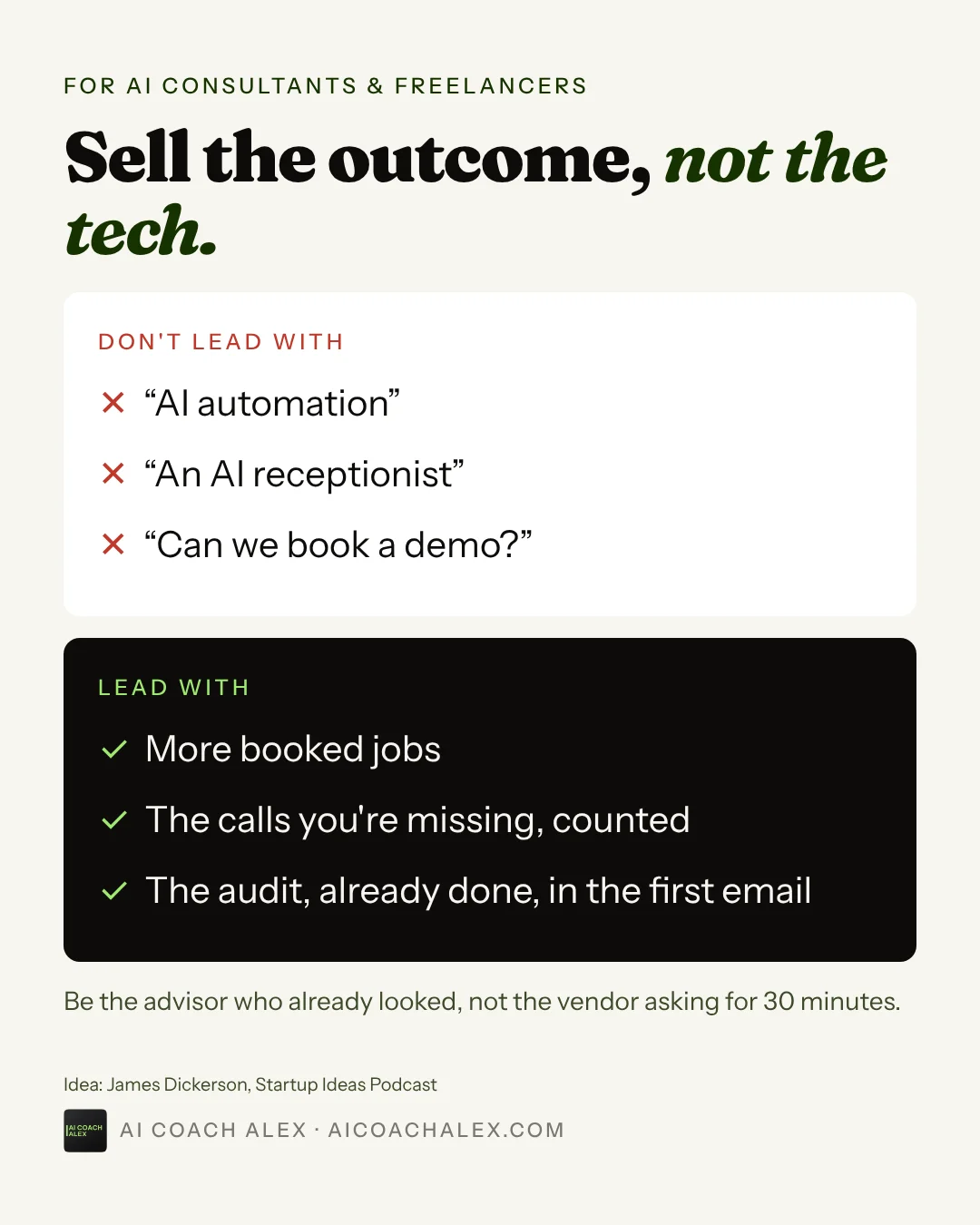
Yes, and it's the most practical playbook I've heard in a while. If you sell AI services, here's what I'd take from James's approach:
- Pick one niche with high-ticket jobs. He avoids low-ticket work and lists underserved trades like commercial hood cleaning, tree services, septic, chimney sweeping and backup generators.
- Do the audit before the first email. His first message already contains the findings and a proposal, not a request for 30 minutes of the owner's time.
- Be an advisor, not a vendor. He borrows Chet Holmes's Dream 100 idea (pick the best prospects and keep showing up with value) and mixes old and new: Meta ads and video, but also physical mail and inviting local owners to a meetup.
- Earn the first case study. He's open about doing a first project for free in exchange for a strong case study or testimonial.
- Report in money. He says AI has taken away much of the reporting work that used to eat agency time. Send a short video or make a call about booked jobs, not a dashboard of clicks.
My own addition, from coaching: don't trash the owner's current setup. They built that page, or paid someone they trust to build it. Show the leak, show the number, fix one thing, and let the result do the arguing.
Prompt 2: turn your audit into a first email
Write a short first email (max 150 words) to the owner of [business name], a [trade] in [city].

What I found when I acted as their customer:
- [finding 1, e.g. the ad promises same-day repair, the page doesn't mention it]
- [finding 2, e.g. 4.9 rating on Google, not shown on the page]
- [finding 3, e.g. 3 screens of scrolling before the booking button]

Rough leak math: [leads per month] × [cost per lead] × [share lost] = [amount] a month.

Rules:
- Lead with booked jobs and money, not AI. Don't use the words AI, automation or agent.
- Be respectful of what they've built. No "your website is bad".
- Include one fix they can make today for free.
- Offer to fix the biggest leak first and measure booked jobs for 2 weeks.
- End with a yes/no question, not a request for a call.
Give me 2 versions: one plain, one warmer.
One honest note. James is less excited than Greg's previous solo episode about AI agents becoming the front door soon. He says his diesel business gets only a couple of visitors a week from ChatGPT, and he's more bullish on Google for now. I think both are right on different timelines: get readable for agents, but fix the human leak first. It's where the money is this month.
Nobody sends you a report of the customers you didn't get. That's why the best first AI project is finding them.
FAQ
How do you sell AI services to small businesses?
Lead with the outcome they already pay for, such as booked jobs, calls and reviews, not with AI. Audit their customer path first, show the leak in money, fix one thing, measure the result, and only then add AI for follow-up and reporting.
What is a leak in a small business's marketing?
Any point where people who already found you drop out before calling or booking: a landing page that doesn't match the ad, hidden reviews, a booking button three screens down, unanswered calls or slow replies on WhatsApp.
How do I calculate how much my website is losing?
Multiply leads per month by your cost per lead and by the share you think you lose. If you don't buy leads, multiply missed enquiries by how often they turn into a job and by your average job value. A rough, conservative number is enough to decide what to fix first.
Should I mention AI when pitching a local business?
Usually not at first. Owners care about revenue and return on investment. Talk about booked jobs and missed calls, show the evidence, and explain the tools later if they ask.
What should a small business fix before buying AI tools?
Check five things: the page repeats the ad's promise, your rating and reviews are visible, people can book or call in one tap on a phone, every enquiry gets a fast answer, and you track booked jobs and cost per lead.
Where does AI help once the leak is fixed?
In speed and consistency: instant replies to forms and messages, missed-call text-back, follow-ups on open quotes, and a weekly report of leads and booked jobs that takes minutes instead of hours.
Find the leak first. Then let AI keep it closed.
One-to-one coaching for business owners: we map how customers reach you, fix the biggest leak, and build the AI follow-up and reporting around it.
Book a 49€ diagnostic → AI for business ownersSources: Greg Isenberg with James Dickerson, "How to Sell AI to Main Street (Full Playbook)", The Startup Ideas Podcast, 26 Oct 2026 (episode transcript on Metacast): the target range, market figures, the five-plumber audit, the leak math, the quote, the outreach methods and the comments on agents and reporting. James Dickerson on LinkedIn. The client stories, points 4–5 of the leak check, the five moves and the prompts are from my own coaching work.