

AI now makes simple software cheap to build, so the old model (pay engineers, charge per seat) is weakening, especially for small businesses. Greg Isenberg calls what comes next smart SaaS: the tool is free, and the money comes from AI agents (paid by the token or the outcome) and human services (paid by the week or month). For a business owner, that means auditing what you pay per seat and asking, job by job, whether you need a tool, an agent or a person. For a consultant, it means selling results, not software.
When I moved my coaching off a marketplace and onto my own website, I had a problem. The marketplace blocks links in messages, so my site and my blog had to become the way people found me. A few years ago that meant hiring a developer, a designer and probably a content agency.
I didn't hire anyone. I built aicoachalex.com myself, with AI. The blog you're reading is part of that: every day an AI pipeline I set up helps me research, draft and publish a news post. And before every lesson I build the student their own interactive dashboard, which I screenshare while we work.
Here's the part that took me a while to see. Nobody pays me for any of that software. Not the site, not the pipeline, not the dashboards. People pay me for the work those things make possible: someone who looks at their business, decides what to build first, and stays with them until it runs.
This week Greg Isenberg put a name on that shift.
Is SaaS really dead? What did Greg Isenberg say?
In a short solo episode of The Startup Ideas Podcast, "SaaS is dead?" (31 Oct 2026), Greg argues that the software business model of the last 15 years has run its course. That model was simple: pay engineers to build a tool, then charge per seat.
His reason: models like Opus 5.5, GPT-6 and Argon now make the tool itself easy to build. If anyone can build the tool, the tool stops being the thing people pay for.
What replaces it is what he calls smart SaaS. You give the tool away for free. The tool collects data and builds network effects, and that's the payment. The money comes from upselling two things on top: intelligence from AI agents, and services from humans. He illustrates it with a calorie-tracking app, and he lays out three ways to charge.

Two details matter for my readers. First, he doesn't think everyone stops paying per seat: SaaS for small businesses, prosumers and individuals trends toward free, while enterprises still pay something per seat. Second, he isn't saying the software market shrinks. His point is the opposite. As the show notes put it, "the market for getting things done is bigger than the market for tools."
That sentence is the whole post. Keep it in mind.
What is smart SaaS, in plain words?

Think of it as three layers stacked on top of each other:
- The tool. The app, the form, the dashboard, the tracker. Increasingly free, because AI makes it cheap to build. You pay with your data instead of your card.
- The agent. AI that does the work inside or on top of the tool. According to Greg, agents can charge by the token (how much AI they use) or by the outcome (the result they deliver).
- The human. A person who sets it up, checks the output, handles the exceptions and owns the result. Charged by the week or the month.
If you run a business, you've probably felt this already without naming it. Your invoices are full of tools priced per seat. Each one promised to save time. But the job you actually wanted done, a quote out the same day, a report on the owner's desk on Monday, still needs someone to make it happen.
What does this mean for small business owners buying AI?
My take, not Greg's: the question changes. You stop asking "which AI tool should I buy?" and start asking "who, or what, should do this job, and how do I pay for the result?"
That sounds abstract, so here's how I'd use it. My first rule with any client is structure before building: map the work before you touch a tool. Do that, and you'll often find that what you pay for and what you need done are two different lists. A tool for scheduling, a tool for forms, a tool for reports, and the report still gets built by hand.
In the smart SaaS world, each of those jobs falls into one of three buckets:
- Tool jobs. Simple, repeatable, well defined. A form, a tracker, a calculator, a one-page dashboard. These are now cheap enough that you can often build them yourself with ChatGPT or Claude, instead of paying for seats on someone else's.
- Agent jobs. Work with a clear "done": a draft quote, a categorised inbox, a weekly summary. Here you want to pay for the result, so you need to write down what a good result looks like.
- Human jobs. Anything that needs judgment, trust or a decision: pricing, hiring, a client complaint, deciding what to automate first. This is where a person earns their fee.
One warning, again my own. "Free" tools are paid for with your data. That's fine when you know it and when you can take your data with you. It's a problem when your client list, your prices and your rules live inside someone else's free app and can't be exported. Your data and your written rules are the only part of this stack that's truly yours. Guard them.
The tool is becoming free. Your rules, your data and your judgment are not. That's where the value moves.
Want to run the Tool, Agent, Human audit with me?
In a 49€ diagnostic call we list what you pay for, map the jobs you actually need done, and pick the first one to move.
Book a 49€ diagnostic →How do you stop paying for seats and start paying for results? 5 moves for this week

- List every seat you pay for. Tool name, plan, number of seats, monthly cost. Pull it from your card statement, not from memory. The first prompt below turns that list into a table.
- Write the job each one is supposed to do. The outcome, not the feature. Not "project management software" but "every job has an owner and a date by Friday".
- Sort each job: tool, agent or human. Could you build a simple version yourself? Is there a clear result an agent could deliver? Does it need someone's judgment? Some jobs are a mix; that's fine, write down which part is which.
- Move one job this month. Just one. Either build the simple tool yourself (the second prompt below helps), or go back to a vendor and ask whether they'll price on results instead of seats. The first one is the hard one. After that it gets easy.
- Own your data and write your rules down. Check that you can export everything from every tool you use. Then write down the rules that live in your head: prices, discounts, what "done" means. Agents are only as good as the rules you give them, and those rules are your edge.
Prompt 1: the seat audit
You are my operations advisor. Below is a list of the software I pay for, with plan, number of seats and monthly cost.

[paste your list]

1. Turn it into a table: tool, seats, monthly cost, and the JOB it is supposed to get done for my business (an outcome, not a feature). If you are not sure what the job is, ask me before guessing.
2. For each job, sort it into one bucket:
   - TOOL: simple and repeatable, I could build a basic version myself with an AI assistant
   - AGENT: has a clear "done" result an AI could deliver and I could pay for per result
   - HUMAN: needs judgment, trust or decisions
   Explain each choice in one sentence.
3. Flag any tool where my data might be hard to export.
4. Recommend the ONE job I should move first, and why. Keep it practical for a small business with no developer.
Prompt 2: build the simple tool yourself
I want to replace a paid tool with a simple one I build myself with your help. The job it needs to do is: [the outcome, e.g. "track every quote we send and remind me to follow up after 3 days"].

Interview me first, one question at a time (max 8 questions), about: who uses it, what information goes in, what should come out, how often, and where it should live (a spreadsheet, a simple web page, or inside this chat).

Then:
1. Propose the simplest version that does the job. No extra features.
2. Build it step by step, explaining what I need to click or paste.
3. Tell me how to export my data from it at any time.
4. List what this simple version will NOT do compared with the paid tool, so I can decide honestly.
Is this an opportunity for AI consultants and freelancers?
A big one. One chapter of the episode is about services becoming the new software, and in Greg's model human services sit right on top of the stack, charged by the week or the month.
For a freelancer or consultant, that means your offer can follow the same three layers:
- A free tool that shows your thinking: a quiz, a calculator, an audit template. It brings people in and tells you what they need.
- An agent you set up for the client, priced on the result it delivers rather than the hours you spent building it.
- Your time, by the week or the month: setting it up, checking it, improving it, training their team.
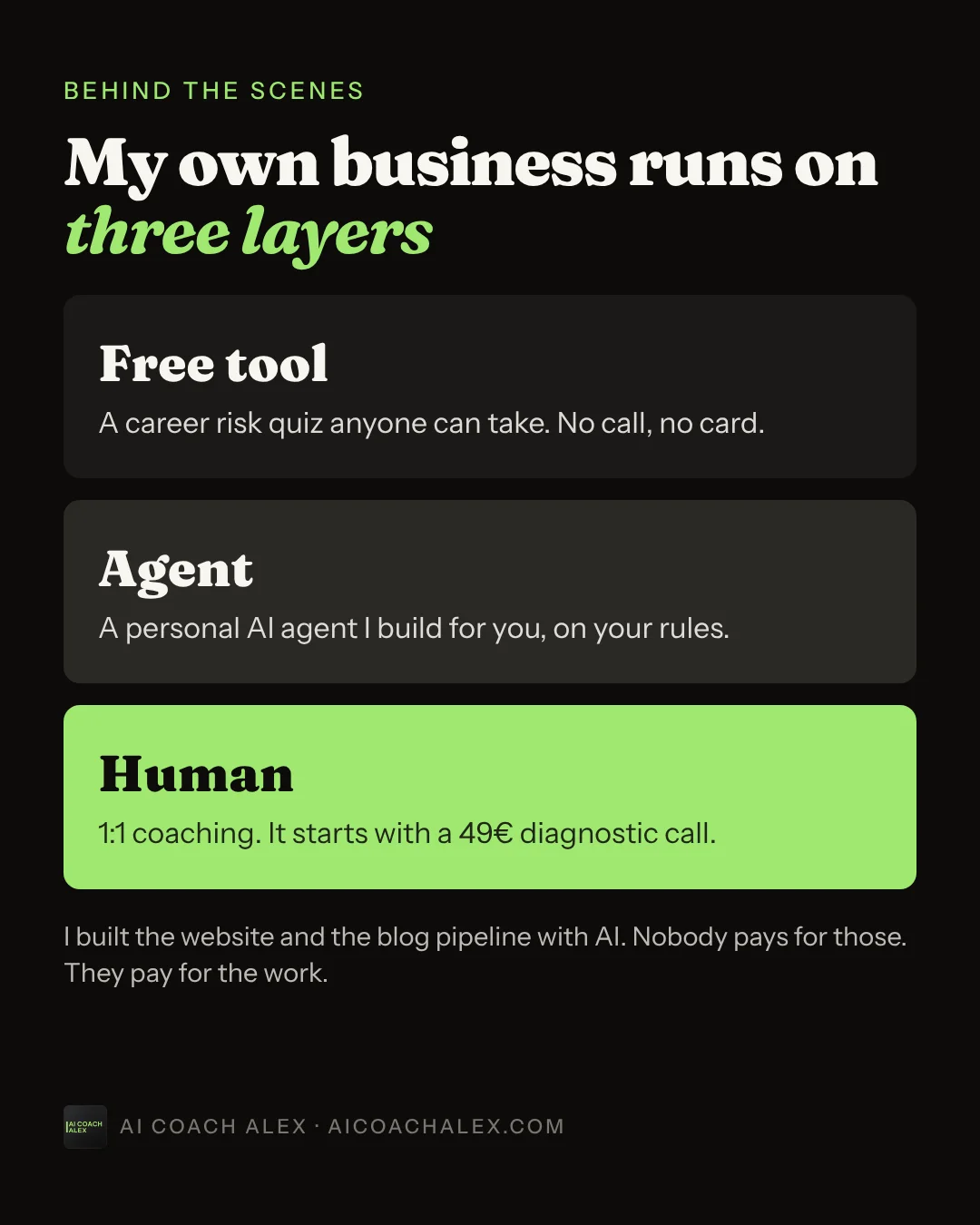
It's how my own business is laid out, though I didn't plan it with this name. There's a free career risk quiz anyone can take. There's a personal AI agent I build for clients who want it done for them. And there's one-to-one coaching for people who want to learn to do it themselves. I built the free layer with AI. The paid layers are the work.
I'm also seeing technical people move this way. One student, a lead software engineer at a UK bank, is building a portfolio of voice AI agents so he can move into a startup or into consulting. He isn't learning to sell software licences. He's learning to sell agents that do a job, plus the expertise to run them.
If you want to build that kind of offer, or apply this audit inside your own company, that's what we work on in AI for business owners.
FAQ
Is SaaS really dead?
Not entirely. Greg Isenberg's argument is that the per-seat model of the last 15 years has run its course because AI makes tools easy to build. He expects SaaS for small businesses, prosumers and individuals to trend toward free, while enterprises still pay something per seat.
What is smart SaaS?
Greg Isenberg's name for the model that replaces classic SaaS: give the tool away for free, collect data and network effects, and make money by upselling AI agents and human services on top.
How will AI agents be priced?
In Greg Isenberg's model, agents can charge by the token, meaning how much AI they use, or by the outcome, meaning the result they deliver. Human services on top are charged by the week or the month.
Should a small business cancel its software subscriptions?
Not blindly. First list what you pay per seat and the job each tool is meant to do. Then sort each job into tool, agent or human, and move one job at a time. Some tools are worth keeping; the audit tells you which.
Are free AI tools safe for business data?
Free tools are often paid for with your data. Before you rely on one, check what data it collects and make sure you can export your client lists, prices and records at any time.
How can AI consultants use this model?
Structure the offer in three layers: a free tool that brings people in, an agent priced on the result it delivers, and your own time by the week or month to set it up, check it and improve it.
Stop paying for seats. Start paying for results.
One-to-one coaching for business owners and consultants: we map the jobs in your business, build the first tool or agent together, and write down the rules that make it work.
Book a 49€ diagnostic → AI for business ownersSources: Greg Isenberg, "SaaS is dead?", The Startup Ideas Podcast, 31 Oct 2026 (episode description, key points and chapters): the end of the per-seat model, smart SaaS, the three layers and how each is charged, SMB vs enterprise, and the "getting things done" market. Client examples, the Tool, Agent, Human audit, the five moves and the prompts are from my own coaching work.