
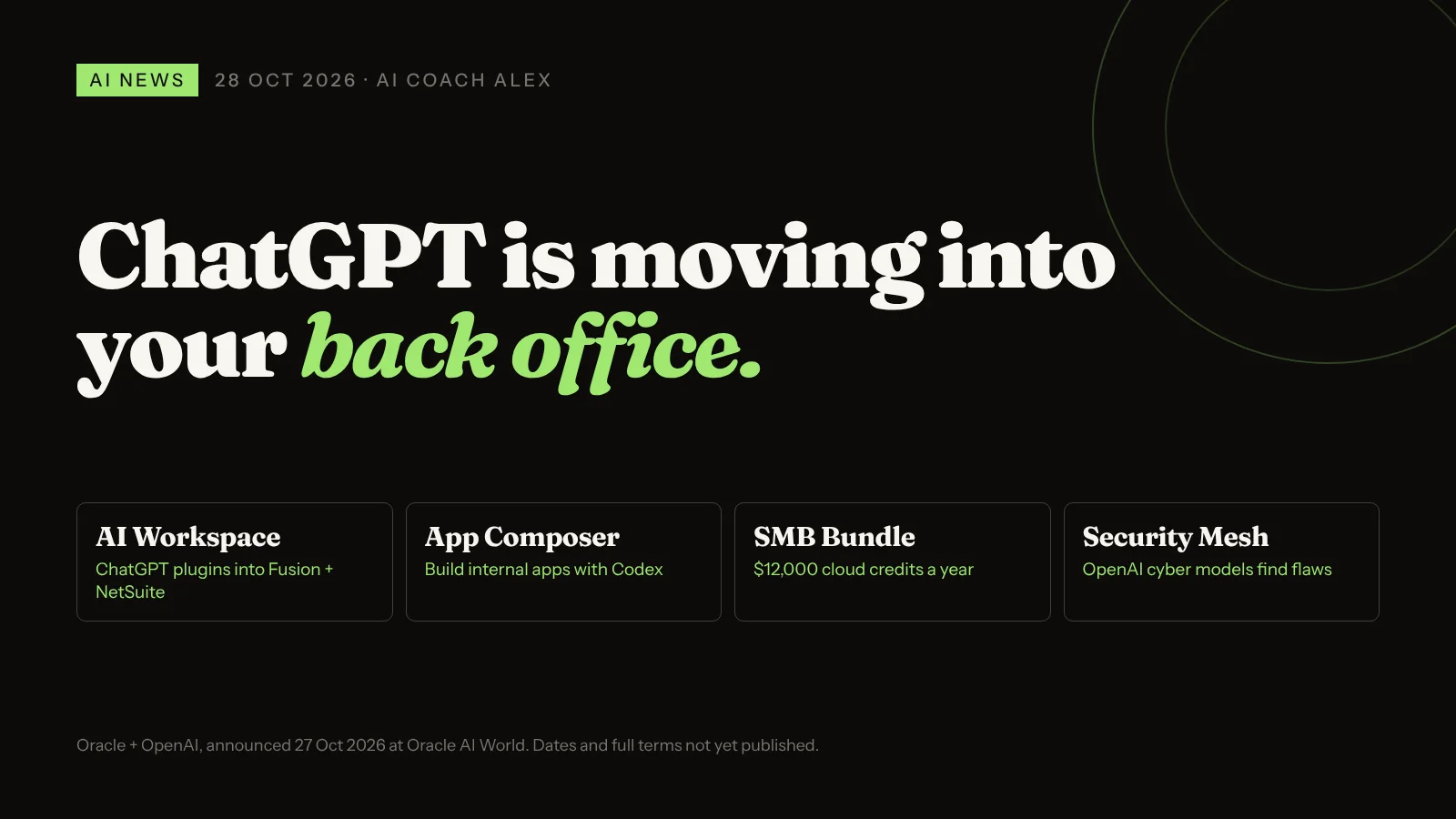
Oracle is putting ChatGPT and Codex inside its business software. A new Oracle AI Workspace lets employees use ChatGPT to look up data and run approved workflows in Oracle Fusion Applications and NetSuite. App Composer lets non-programmers build internal apps with Codex. For small businesses there's an "Oracle AI SMB Bundle": ChatGPT Business, the Workspace, Codex, NetSuite QuickStart for invoicing and cash flow, and $12,000 of Oracle cloud credits a year, described as free to start. No launch dates, eligibility rules or full terms have been published yet. Don't switch software for it. Use the wait to get your data, categories and approval rules in order, because that's what decides whether any AI can run your back office.
In almost every first session with a business owner, there's a moment where I connect their AI to the software that runs the business and ask it a simple question. "Which clients owe us money?" "Where did our leads come from this month?"
The answer is never the problem. The data behind it is. Jobs with no category. Two spreadsheets that disagree. A discount policy that only exists in the owner's head. The AI does exactly what it's told, and that's when everyone discovers nobody ever told it, or anyone else, how the business really works.
That's why yesterday's announcement from Oracle and OpenAI matters more than the headline suggests. Chat is becoming the front door to business software. Whether that door opens onto a tidy office or a messy one is up to you.
What did Oracle and OpenAI announce?
At Oracle AI World in Las Vegas on 27 October, Oracle announced a set of products that combine OpenAI's models, ChatGPT and Codex with Oracle's applications and cloud. According to Oracle's press release, there are four pieces:
| What was announced | What it means in plain English |
|---|---|
| Oracle AI Workspace: plugins in ChatGPT connect to Oracle Fusion Applications, NetSuite, Oracle AI Database and Oracle Cloud | You ask ChatGPT a question about your business, and it pulls the answer from your ERP or accounting system, or runs a workflow you've approved |
| Oracle App Composer: build business apps with Codex; Oracle hosts and runs them | A manager who can't code describes a small internal tool (a stock checker, an approvals form) and gets a working app with company permissions applied |
| Oracle AI SMB Bundle: ChatGPT Business, AI Workspace, Codex and App Composer, Oracle Cloud, NetSuite QuickStart for invoicing and cash flow, plus $12,000 in Oracle cloud credits a year | A packaged way for a small business to get ChatGPT, accounting software and app-building in one place. "Free to start", but Oracle says terms, conditions and restrictions apply and hasn't published them |
| Oracle AI Security Mesh: a managed service using OpenAI's cyber models to find and fix vulnerabilities | Mostly for larger IT teams. You set what the AI is allowed to test; Oracle runs the safeguards |
| No dates, prices or regions for Workspace, App Composer or Security Mesh | This is an announcement, not something you can switch on today |
Oracle also said its cloud will offer Google's TPU chips, OpenAI's own inference chip and Cerebras systems, as reported by Data Studios. That's the infrastructure story. For a business owner, the interesting part is the software.
Small Business Trends makes the right point about the bundle: it doesn't say whether every service in it is covered by the credits, so confirm costs, usage limits and eligibility with Oracle before you plan around it.
Why does ChatGPT inside business software matter to small businesses?
Because it's the same move everyone is making. Microsoft has Copilot inside Office. Google pitched its Gemini agent working inside Gmail, Sheets and business tools earlier this month. Now ChatGPT is going inside an ERP and accounting suite. Within a year, most software you pay for will have a chat box that can read your data and, with permission, act on it.
Three things follow from that:
- The chat answer is only as good as the records behind it. If half your jobs have no client type, "Which kind of client is most profitable?" gets a confident, wrong answer.
- "Approved workflows" have to be approved by someone. Oracle stresses governance and approvals. That only works if you've decided who can approve what, and up to which amount.
- Bundles create lock-in. $12,000 of credits a year is real money. It's also how platforms get you to move your invoicing, cash flow and internal apps into one place. That can be fine. Just decide it on purpose.
Is your business data ready for AI?
Three moments from my own coaching sessions, all anonymised, all things I see again and again.
With an electrical contractor in Sydney, the first test of his AI accounts chat surfaced an overdue payment nobody had flagged. Good news. Then we tried to report on job types and found most jobs had no client category. We had to write a categorisation rulebook before the AI could answer anything useful.
With an events production company in Italy, we built an agent that turns a site-visit transcript into a client quote. It couldn't apply discounts, because the discount policy had never been written down.
With a real-estate agency in Dubai, a campaign to their existing contacts waited until the CRM was cleaned. Running AI on messy data just sends the mess faster.
None of these were AI problems. They were "the business never wrote its own rules" problems. AI just made them visible. Every new back-office AI, from Oracle or anyone else, will hit the same wall.
How to get your business ready for back-office AI
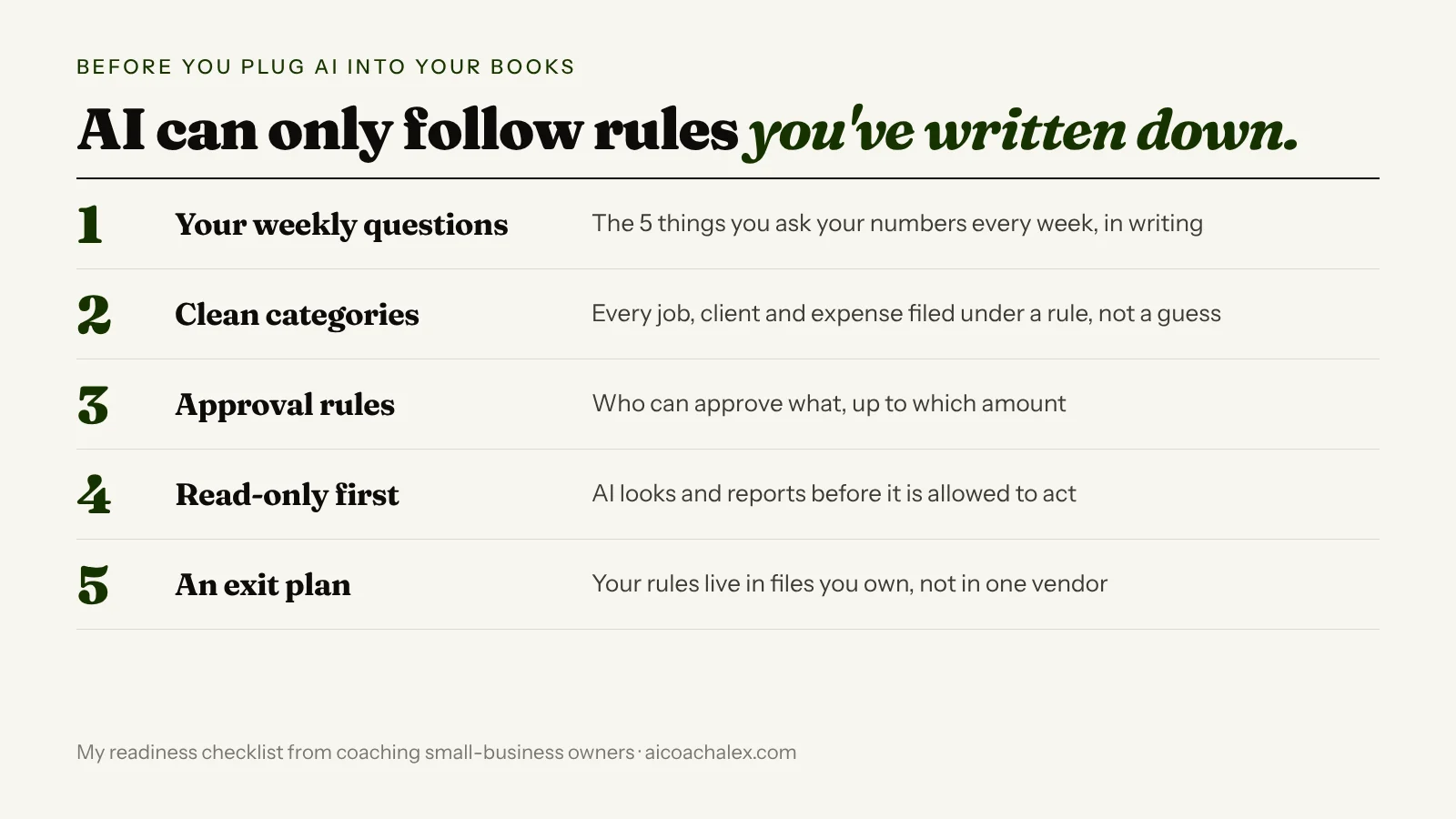
- Don't switch software for a launch announcement. If you already run NetSuite, watch for the Workspace rollout. If you don't, check first whether your current accounting or job-management tool already connects to ChatGPT or Claude. A connector to the system you have usually beats a migration.
- Write down your five weekly questions. The things you actually check: who owes us money, which jobs ran over, where leads came from, what's due this week, cash in the bank versus bills due. These become your first AI tests.
- Fix categories before you ask questions. Pick 5 to 8 client or job types, write one line defining each, and apply them to the last three months of records. An afternoon of this beats weeks of wrong answers.
- Write your approval rules. Who can approve a quote, a refund, a supplier payment, and up to what amount. One page. This is what "approved workflows" will need, in any tool.
- Start read-only. For the first month, the AI looks and reports. It doesn't send, pay, change or delete. Check its answers against what you know.
- Keep your rules in files you own. Your categories, approval rules and weekly questions should live in a document you control, so you can take them to the next tool. That's your exit plan.
Copy this prompt: your back-office AI readiness check
Paste this into ChatGPT or Claude. It interviews you and hands back the rulebook any back-office AI will need, whichever software you end up using.
Act as an operations consultant helping a small business
get ready to connect AI to its accounting and admin software.

MY BUSINESS: [what we sell, team size, country]
SOFTWARE WE USE: [accounting, CRM, job management, spreadsheets]
WHERE THINGS GET MESSY: [e.g. jobs without categories,
  quotes in WhatsApp, two spreadsheets for the same thing]

Interview me one question at a time (max 12 questions), then write:
1. MY 5 WEEKLY QUESTIONS: what I should be able to ask an AI
   about my numbers every week, in plain words.
2. CATEGORY RULEBOOK: 5-8 client/job/expense categories,
   one-line definition each, and how to handle edge cases.
3. APPROVAL RULES: who approves quotes, refunds, discounts and
   supplier payments, and the limits for each.
4. READ-ONLY TESTS: 5 questions to test an AI on my data, with
   how I can check each answer myself in 2 minutes.
5. DATA GAPS: what's missing or inconsistent today, ranked by
   how much it would mislead an AI.
6. NEVER WITHOUT ME: the actions an AI must never take without
   my explicit approval.

Keep it to two pages. Plain English, no jargon.
"ChatGPT can read our accounts now, so it'll tell us what's going on." It does, confidently, using categories nobody applied and rules nobody wrote.
Five weekly questions, a one-page category rulebook, written approval limits, and a month of read-only answers you've checked. Then you let it act.
If you're wondering how an AI should handle the steps where it acts on your behalf, read yesterday's post on giving computer-use agents a leash. For why vendor terms matter as much as features, see Meta's new AI terms. And for why your rules should live in portable files, Agent Skills as an open standard.
Is your business ready to plug AI into the books?
In a 49€ diagnostic call we look at the software you already run, find the gaps that would mislead an AI, and pick the first weekly question worth automating.
Book a 49€ diagnostic →Also today in AI
Google DeepMind's Genie 4 generates interactive worlds, now with sound
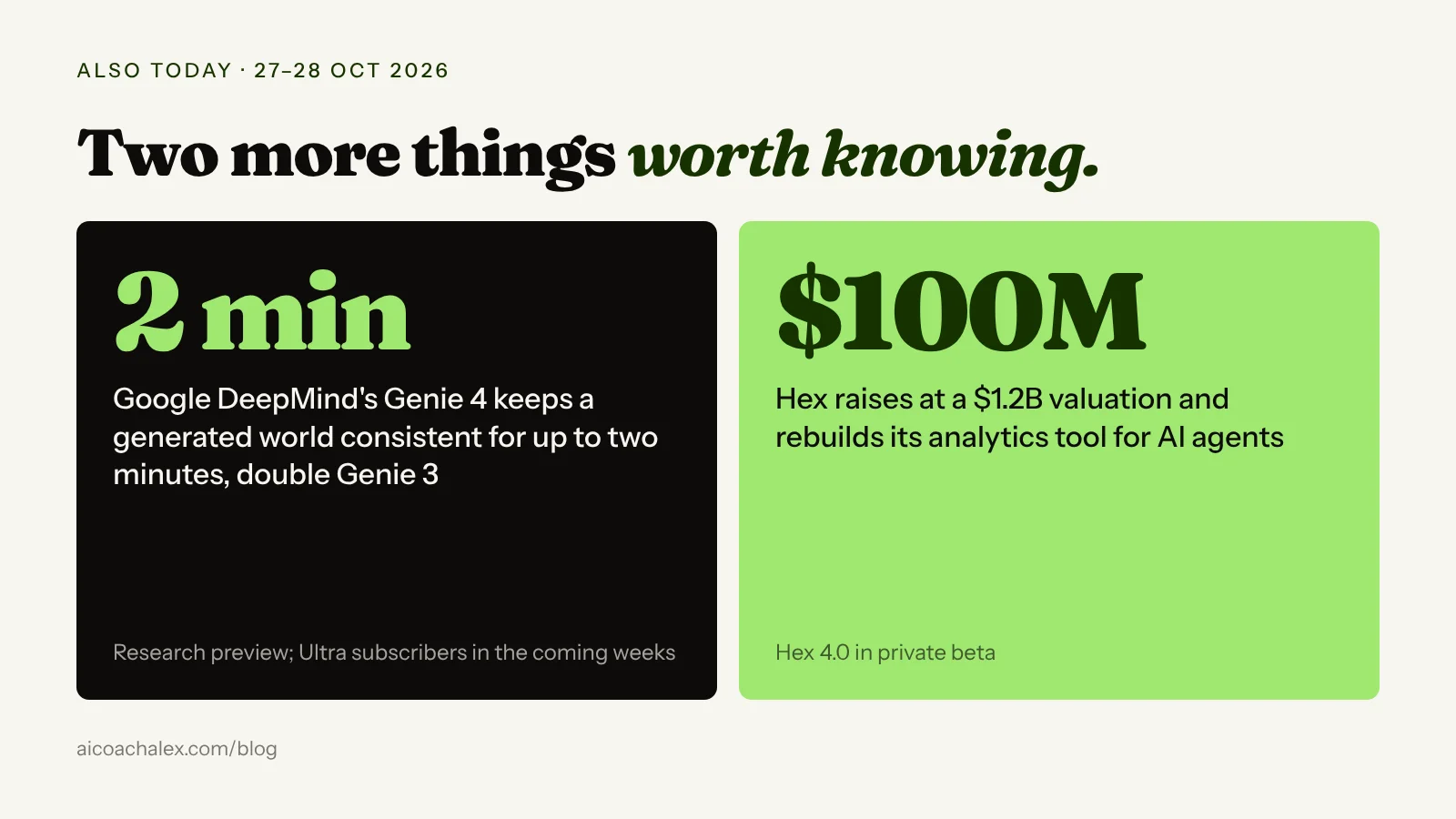
Google DeepMind announced Genie 4, a "world model" that generates explorable, interactive scenes from a prompt. TechCrunch reports it now creates matching audio (music, ambient sound, dialogue), lets you change the scene mid-session by typing, and keeps a world consistent for up to two minutes, double Genie 3. It's in research preview for trusted testers, rolling out to Google AI Ultra subscribers and early API partners in the coming weeks. Google says details can still drift and in-world text isn't legible yet.
What it means for you: not a business tool yet. But testers see it for storyboarding and prototyping. If you make video or training content, it's worth a look when it reaches you, for sketching a scene before you spend money producing it. My beginner's guide to AI video covers the tools you can use today.
Hex raises $100M and rebuilds its analytics tool for AI agents
Data analytics company Hex announced a $100 million round at a $1.2 billion valuation, led by Peak XV and 137 Ventures, and Hex 4.0, a from-scratch rebuild for humans and AI agents working on data together. In its announcement, Hex says agents wrote much of the new code. For non-technical users, the notable feature is that any number in a report can be traced back to its logic and data source, with a signal for whether a figure rests on a trusted definition or needs a data team's review. It's in private beta.
How to use it: borrow the idea even if you never use Hex. When an AI gives you a number about your business, ask it to show where the number came from and how it was calculated. If it can't, don't make a decision on it.
FAQ
What did Oracle and OpenAI announce on 27 October 2026?
At Oracle AI World, Oracle announced Oracle AI Workspace (ChatGPT plugins connected to Oracle Fusion Applications, NetSuite and Oracle's database and cloud), Oracle App Composer (building business apps with Codex), Oracle AI Security Mesh (vulnerability testing with OpenAI cyber models) and an Oracle AI SMB Bundle for small businesses.
What is in the Oracle AI SMB Bundle?
ChatGPT Business, Oracle AI Workspace, Codex and App Composer, Oracle Cloud Infrastructure, NetSuite QuickStart for invoicing and cash flow, and $12,000 in Oracle cloud credits per year. Oracle describes it as free to start but says terms, conditions and restrictions apply, and hasn't published them yet.
Can I use ChatGPT with NetSuite now?
Oracle hasn't given a launch date for AI Workspace, which is the product that connects ChatGPT to NetSuite. Its press release includes a standard disclaimer that timing, features and pricing may change. Watch Oracle's and NetSuite's announcements for the rollout.
Should my small business switch to NetSuite for the bundle?
Not on the strength of an announcement. Check first whether your current accounting or job-management software already connects to ChatGPT or Claude, and wait for the bundle's full terms, eligibility and what the credits actually cover.
How do I prepare my business data for AI?
Write down the five questions you ask your numbers every week, define 5 to 8 categories for clients, jobs and expenses and apply them to recent records, write one page of approval rules, start with read-only AI access, and keep these rules in files you own.
What is Genie 4?
Google DeepMind's latest world model, announced on 27 October 2026. It generates interactive scenes with matching audio from a prompt and keeps them consistent for up to two minutes. It's in research preview, rolling out to Google AI Ultra subscribers and early API partners in the coming weeks.
Get your business AI-ready before the tools arrive.
One-to-one coaching for business owners: we map your admin, write the rules your AI needs, connect it to the software you already use and build your first weekly report on your real data.
Book a 49€ diagnostic → AI for Business OwnersSources: Oracle press release (27 Oct 2026); Small Business Trends (27 Oct 2026); Data Studios (27 Oct 2026); Techzine (27 Oct 2026); TechCrunch on Genie 4 (27 Oct 2026); Hex: Announcing our $100M raise and Introducing Hex 4.0 (27 Oct 2026). Client examples are anonymised from my own coaching work; recommendations are mine.