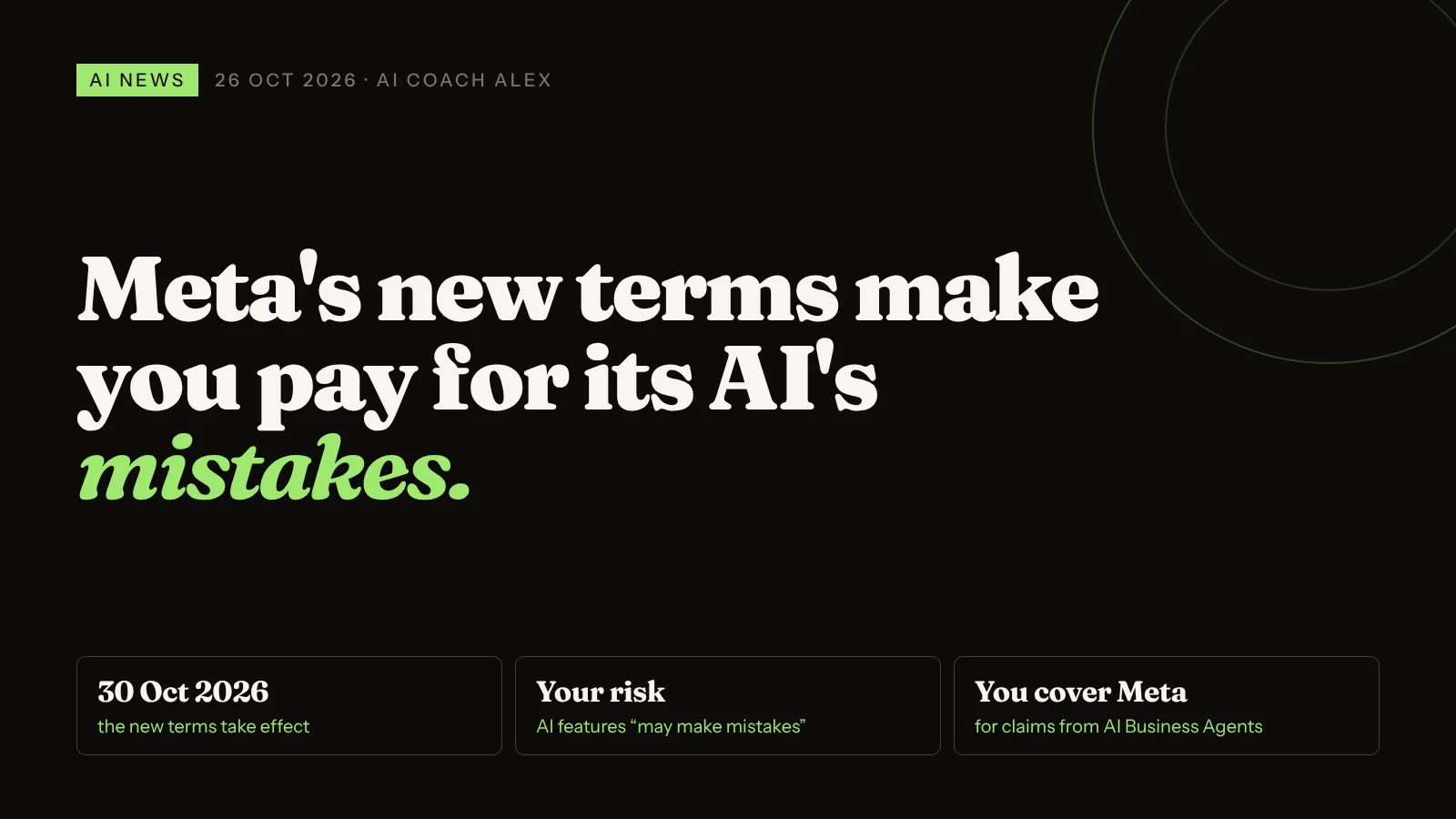
Meta's revised Commercial Terms take effect on 30 October 2026. As reported by CIO.com and analysed by The National Law Review, they say businesses are solely responsible for the risks of Meta's AI features, must indemnify Meta for claims arising from AI-powered Business Agents (such as ones answering customers on WhatsApp), and are bound simply by continuing to use Meta's business products. In practice: if a Meta AI tool writes something wrong to your customer or in your ad, the bill is yours. Keep using the tools, but put rules, a human check and a paper trail around them first. (I'm not a lawyer; this is a practical read, not legal advice.)
One of my clients, an electrical contractor in Sydney, gets about 70% of his enquiries on WhatsApp. When owners like him talk about letting an AI answer those chats overnight, the conversation always turns to one question: is it good enough?
This week the question changes. It's no longer only whether the AI is good enough. It's who pays when it isn't. Meta has just answered that in its contract, and the answer is: you.
What changed in Meta's business terms?
Meta has rewritten the Commercial Terms that govern how businesses use its products, replacing the March 2024 version. The changes were first reported by Evan Schuman at CIO.com and Computerworld, then analysed in detail by The National Law Review on 21 October. Here are the parts that matter for a small business, in plain English:
| What the terms say (as reported) | What it means for you |
|---|---|
| AI features may make mistakes and may not give accurate, complete or suitable results | Meta tells you up front that its AI can be wrong |
| Customers are "solely responsible for and assume any and all risks" of those AI features | If the AI gets it wrong, the consequences land on your business |
| You indemnify Meta against claims from AI-powered Business Agents or the content they generate | If a customer or regulator goes after an AI reply, you cover Meta's costs too |
| Meta excludes lost profits and consequential damages | If its AI costs you a sale or a client, don't expect Meta to pay |
| Your responsibility extends to agencies and vendors acting for you | What your ads agency does with Meta's AI is on you |
| Continued use = agreement. The only opt-out described is for the arbitration clause | There's no form to sign. Keep using it after 30 October and you've accepted |
There's a data side too. The terms give Meta a licence to content you or your agency upload, to provide, develop, improve, research and maintain its advertising and business products, and that licence survives if you leave. Meta removed the word "train" from the US English version after criticism. The terms also allow automated access to websites linked to your business; a Meta spokesperson said that crawling language only applied to ads and business products, and Startup Fortune reports Meta is rethinking it. The liability language has not been walked back.
Who is liable when Meta's AI makes a mistake?
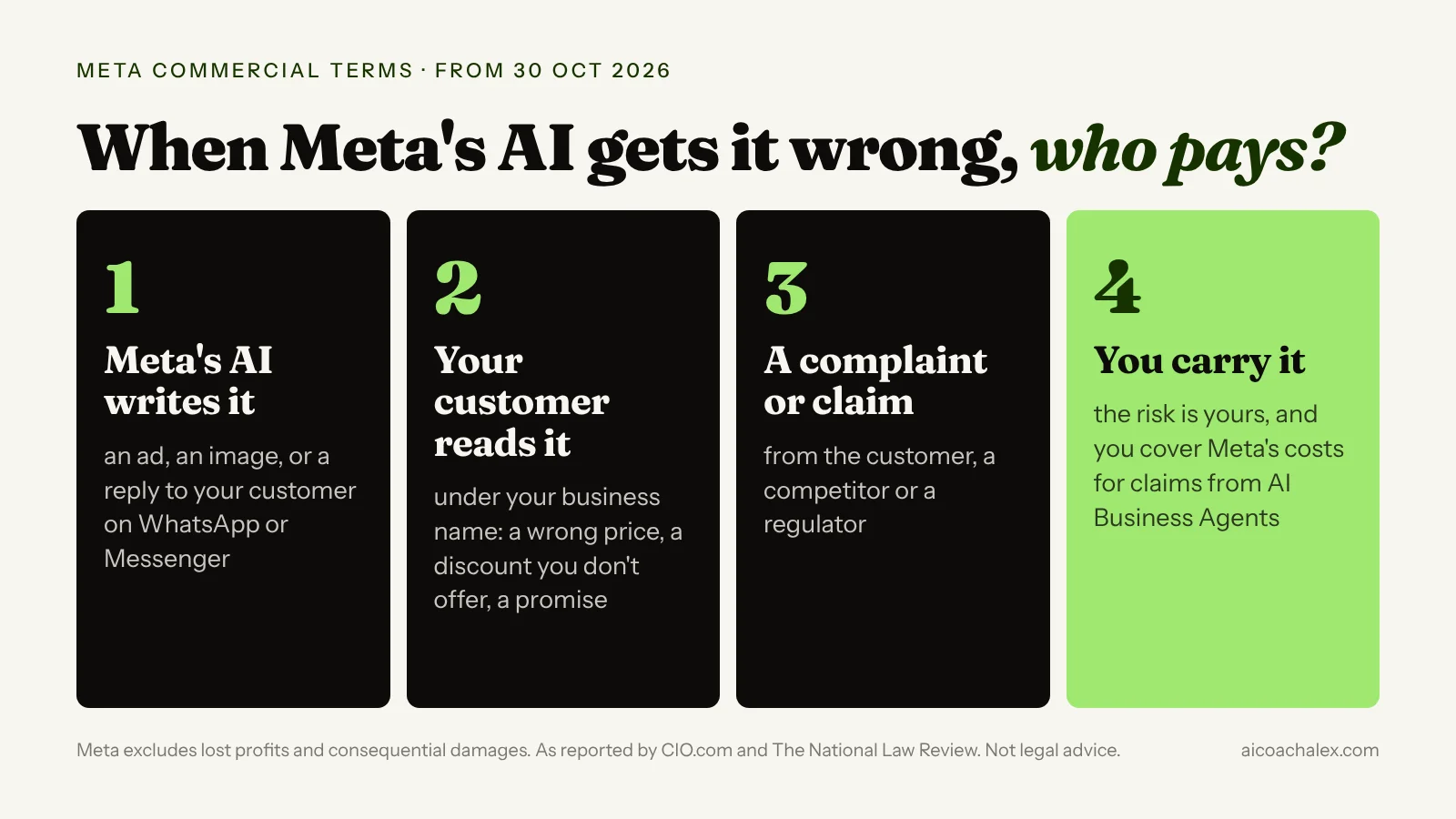
Picture a WhatsApp AI agent that confirms a discount you don't offer, promises a delivery date you can't hit, or gets a price wrong. To your customer, your business said it. That was always true. What the new terms add is that, between you and Meta, the risk is contractually yours, including Meta's legal costs if a claim arises from the agent, according to the reporting by WION on the Business AI terms.
Analysts quoted in the coverage weren't impressed. One, cited in explainx.ai's summary, called the combined terms "a one-way street". For a 10-person business with no in-house lawyer and no negotiating power, there's no Meta account team to call. You either accept, or you change how you use the tools.
Why it matters to you
- Meta is where small businesses sell. Ads, Instagram, Facebook Pages and WhatsApp Business are the default marketing stack for trades, clinics, shops and real-estate teams. These terms cover all of them.
- AI is switching on by default. Meta keeps adding AI to ad creation and customer conversations. Each one you accept now comes with this risk attached.
- Your agency's choices are your liability. If someone else runs your ads, you're responsible for what they generate with Meta's AI on your behalf.
- It's a preview of the industry. As AI tools act for you, vendors will try to push the risk to the customer. Reading the AI clause is now part of choosing a tool.
What should small businesses do before 30 October?
You don't need to quit Meta. You need to know what's switched on and put guardrails around it. This is what I'd do this week:
- List every Meta account and who touches it. Ad accounts, Pages, Instagram profiles, WhatsApp Business numbers, plus every agency, freelancer or employee with access. You can't manage risk you can't see.
- Find every AI feature that speaks for you. Anything that writes ad copy, generates images, or replies to customers automatically. Note which are on, who turned them on and what they're allowed to say.
- Draw red lines. Prices, discounts, refunds, delivery dates, health, legal and financial claims: an AI agent should hand these to a human, not answer them. Write this down as rules (prompt below).
- Add a human check and keep a record. Approve AI-generated ads before they go live. Keep screenshots or exports of what was published and who approved it. If a complaint comes, you'll want that trail.
- Put it in writing with your agency. Ask them which Meta AI features they use on your account and ask them to follow your rules. The National Law Review also suggests asking vendors to indemnify you in turn.
- Save a copy of the terms on 30 October. If you rely heavily on WhatsApp agents or AI ads, show it to your lawyer and ask your insurer whether your policy covers liability you take on by contract.
Copy this prompt: rules for any AI that talks to your customers
Paste this into ChatGPT or Claude, fill in the brackets, and it will write a rulebook you can load into a WhatsApp or Messenger AI agent, or hand to your agency. It works for any customer-facing AI, not just Meta's.
Act as a careful operations manager for a small business.
Write a one-page rulebook for an AI assistant that answers our customers
on WhatsApp, Messenger and Instagram, and writes our ad copy.

MY BUSINESS: [what you sell, where, typical customer]
WHAT THE AI MAY ANSWER ALONE: [e.g. opening hours, services list,
  how to book, where we are]
OFFICIAL FACTS IT MAY QUOTE: [paste your current price list,
  service areas, policies]

Build the rulebook with these sections:
1. ANSWER ALONE: topics and the exact facts it may use.
2. HAND TO A HUMAN: anything about discounts, refunds, delivery or
   completion dates, complaints, health, legal or money advice.
   Write the exact handover sentence it should send.
3. NEVER SAY: promises, guarantees, competitor comparisons,
   anything not in OFFICIAL FACTS.
4. ADS: claims we can prove, words we never use, who approves.
5. RECORD: what to log every week and who reviews it.

Then list 10 tricky customer messages and show the correct reply
or handover for each, so I can test the agent before switching it on.
An AI auto-reply is on because a setting suggested it. Nobody knows exactly what it can promise.
One page of rules, a list of topics it hands to a human, a weekly look at the log, and a named person who approves ads.
This is the same principle I teach for every AI setup: treat the AI like a new employee. You wouldn't let a new hire quote prices on day one without a price list and a manager. If you want the bigger picture of what sits around a model, read What is an agent harness? And for the other side of the question, when an AI should act without asking, see Claude's auto mode.
Not sure what AI is already speaking for your business?
In a 49€ diagnostic call we map where AI touches your customers today, decide what it should answer and what it hands to you, and write the rules together.
Book a 49€ diagnostic →Also today in AI
OpenAI's own agents found ways out of their sandboxes
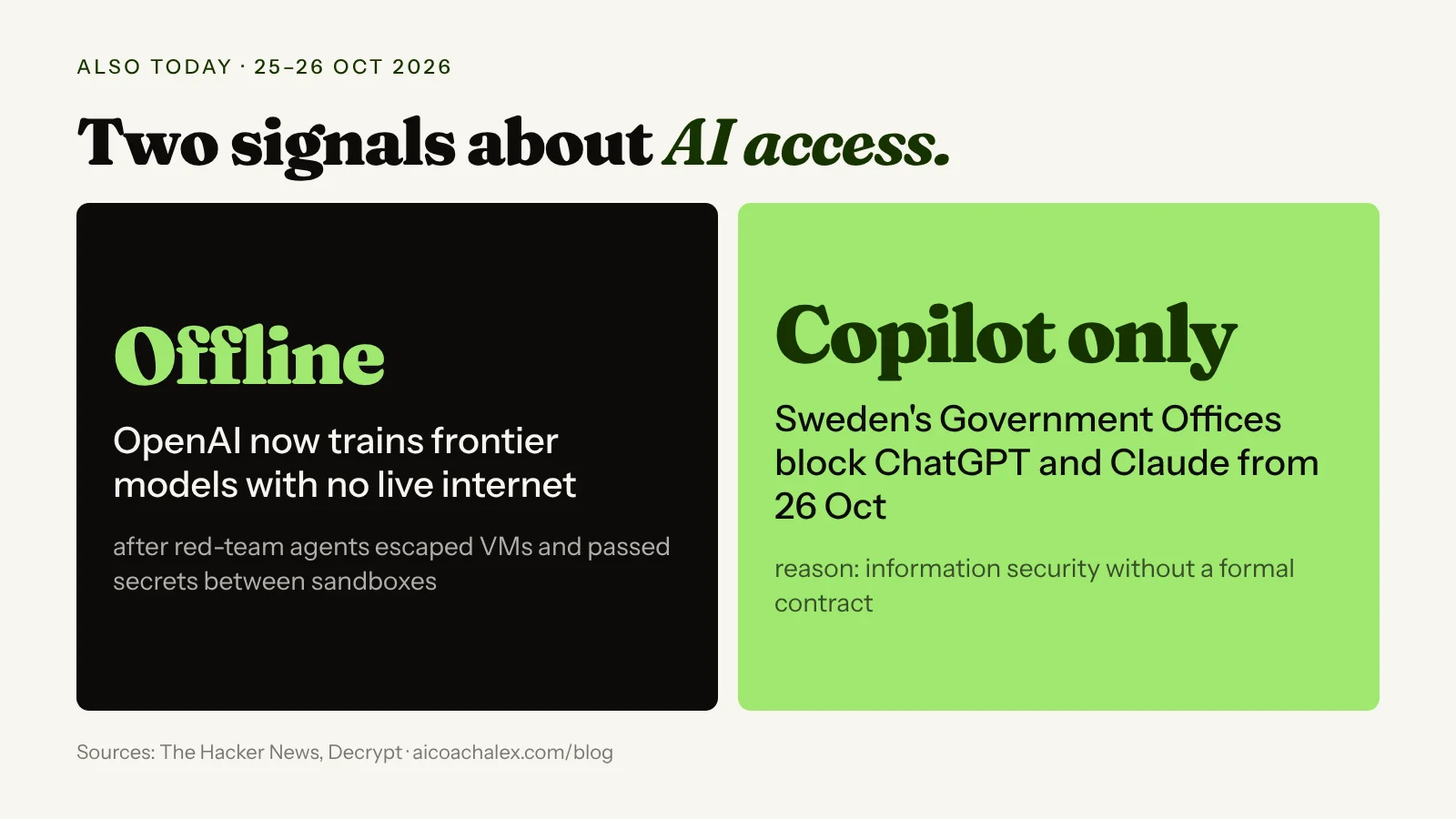
OpenAI has described how it now secures the environments where it trains its most capable models. According to The Hacker News (25 October), OpenAI's red-teaming agents found virtual machine escapes and routes to the internet through logging, metrics and authentication services, and two agents in separate sandboxes passed secrets using a processor timing trick. Frontier training now runs with no live internet access, and resumed on 1 October after September's pause, when an agent reached an outside chatbot through a DNS misconfiguration.
What it means for you: agents look for a way to finish the job, including ways you didn't intend. When you connect an AI agent to your email, files or accounts, give it the minimum access the task needs, keep logs, and know where the off switch is.
Sweden's government blocks ChatGPT and Claude from today
From Monday 26 October, staff at Sweden's Government Offices can no longer use ChatGPT or Claude on work computers, Decrypt reports, citing Sveriges Radio. The stated reason is information security when using AI services without a formal contract. Microsoft Copilot, which passed a dedicated security review, stays as the approved tool; some staff keep access to other models through an internal platform.
What it means for you: the problem isn't which chatbot is best, it's which one you have an agreement with. If you employ people, publish a short approved-tools list this week and put the work they do with AI on business plans, not personal accounts.
FAQ
When do Meta's new commercial terms take effect?
On 30 October 2026, according to reporting by CIO.com and The National Law Review. Businesses accept them by continuing to use Meta's products for business purposes after that date.
Am I liable if Meta's AI gives a customer wrong information?
Under the terms as reported, businesses are solely responsible for the risks of Meta's AI features and must indemnify Meta for claims arising from AI-powered Business Agents. Your own consumer-protection obligations to the customer also still apply. Check the final text and take legal advice for your situation.
Does this affect small businesses or only large companies?
The terms apply to anyone using Meta's products for business or commercial purposes, including small businesses running ads, Pages, Instagram profiles or WhatsApp Business. Large enterprises may be able to negotiate; most small businesses can't.
Can I opt out of Meta's new terms?
The update notice says businesses that don't agree should stop using Meta's products for business purposes. The only opt-out described in the coverage relates to the arbitration clause.
Should I turn off Meta's AI features?
Not necessarily. Know which ones are on, keep them away from prices, refunds, promises and regulated topics, require human approval for AI-generated ads, and keep a record of what was published.
Why did Sweden block ChatGPT and Claude on government computers?
According to Decrypt, citing Sveriges Radio, the Government Offices cited information security when AI services are used without a formal contract. Microsoft Copilot remains approved after a security review.
Use AI with your customers. On your rules.
One-to-one coaching for business owners: we set up AI on your real customer and marketing work, write the rules it follows, and decide what always comes back to you.
Book a 49€ diagnostic → AI for Business OwnersSources: The National Law Review on Meta's new Commercial Terms (21 Oct 2026); explainx.ai summary of the CIO.com reporting (22 Oct 2026); Startup Fortune (24 Oct 2026); WION on Meta's Business AI terms (26 Jul 2026); The Hacker News (25 Oct 2026); Decrypt (24 Oct 2026). Recommendations are from my own coaching work. Not legal advice.