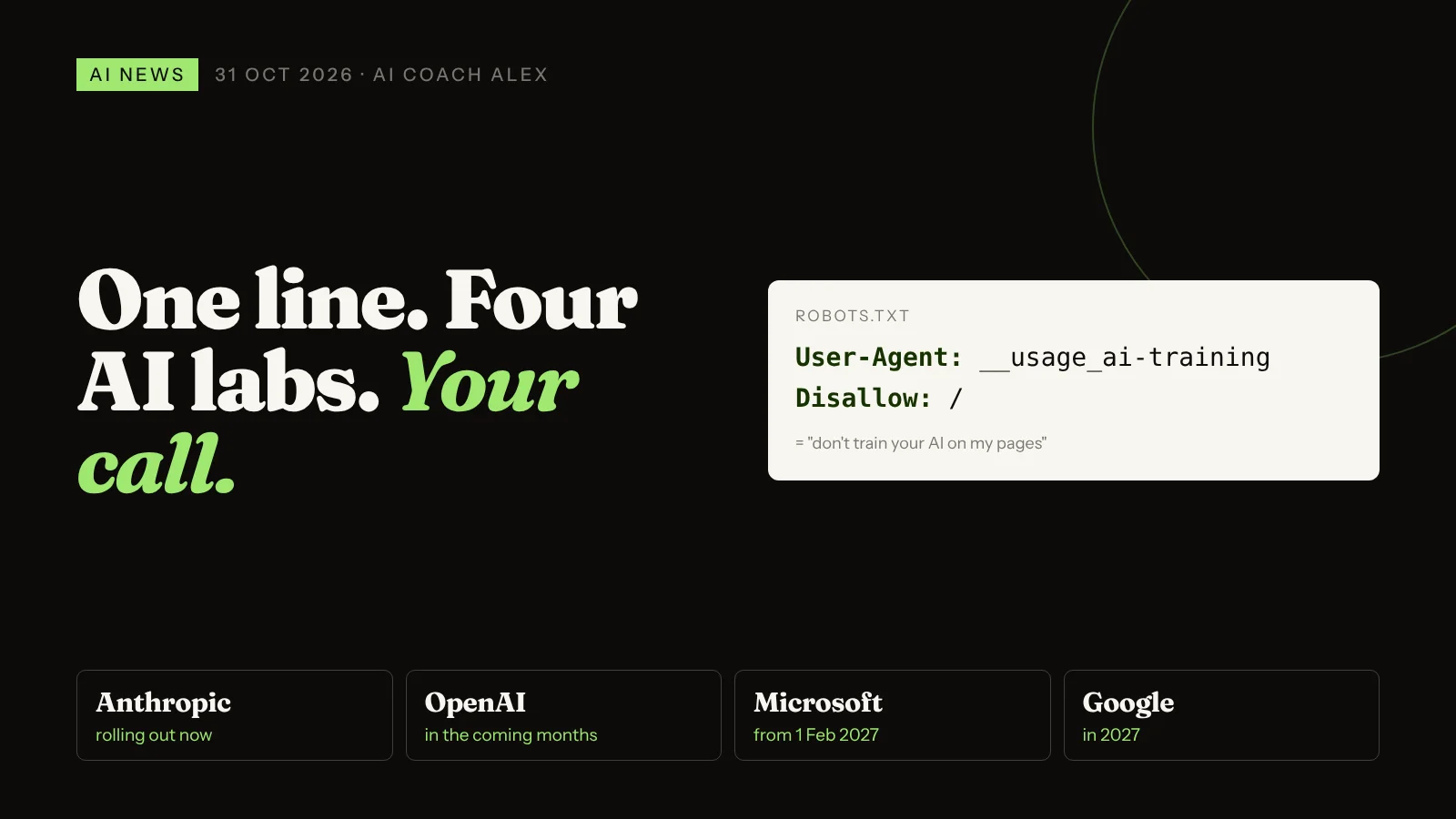
There is now one shared way to tell the big AI labs not to train on your website. On 30 October, OpenAI, Google, Microsoft and Anthropic said they will honour a new robots.txt token, __usage_ai-training, proposed in an IETF draft by Anthropic's Kevin Kelley. Anthropic has started rolling it out, OpenAI says in the coming months, Microsoft from 1 February 2027 and Google in 2027. It only covers training: it doesn't stop bots from visiting, doesn't remove what's already been collected, and doesn't affect Google or Bing search rankings. For most small businesses that want to be found, the smart move is to decide on purpose, not block everything.
Every few weeks a client asks me some version of "is AI stealing my website?" The honest answer has been messy: each AI company had its own crawler name, its own rules and its own small print. Blocking them meant keeping a list, and you never knew if you'd caught them all.
Yesterday that got simpler. Not solved, but simpler. And it forces a question most business owners haven't thought through: do you actually want AI to stop learning from you?
What is the new AI training opt-out token?
As AI Weekly summarised The Verge's report, the four companies are backing one shared signal for publishers. It comes from an Internet-Draft called "Machine-Readable Training Preference Signal", written by Anthropic's standards lead Kevin Kelley and dated 30 October. It's an individual draft, so it has no formal IETF standing yet, but the four biggest labs have said they'll follow it.
In practice it is two lines in the robots.txt file that already sits at the root of your website:
| Question | The answer | In plain English |
|---|---|---|
| What do I add? | User-Agent: __usage_ai-training then Disallow: / | "Don't use any of my pages to train AI" |
| Can I allow some pages? | Yes, with Allow: lines, like any robots.txt rule | Block the blog, keep the services page open, or the reverse |
Does User-agent: * cover it? | No. The draft deliberately keeps the wildcard blind to this token | You must add the line by name |
| Who will honour it? | Anthropic (started), OpenAI (coming months), Microsoft (1 Feb 2027), Google (2027) | Not all at once, and not yet everywhere |
| Old rules? | Bot-specific rules such as Google-Extended keep working. Google will treat the new token as a Google-Extended block if you have no separate rule | Nothing you set before breaks |
| Who's missing? | Meta called a common signal "an important step" but hasn't committed to honour it | Not every AI company is in |
The draft was shaped with input from organisations including Cloudflare, News Corp, the Financial Times, the BBC, the EFF, Creative Commons and Common Crawl, according to AI Weekly. A write-up of SiliconANGLE's coverage on DEV confirms the same token and timelines.
Does blocking AI training remove my website from ChatGPT or Google answers?
No, and this is where most people will get it wrong. The token is about training: what goes into the next model. It is not about fetching: the AI visiting your page today to answer someone's question.
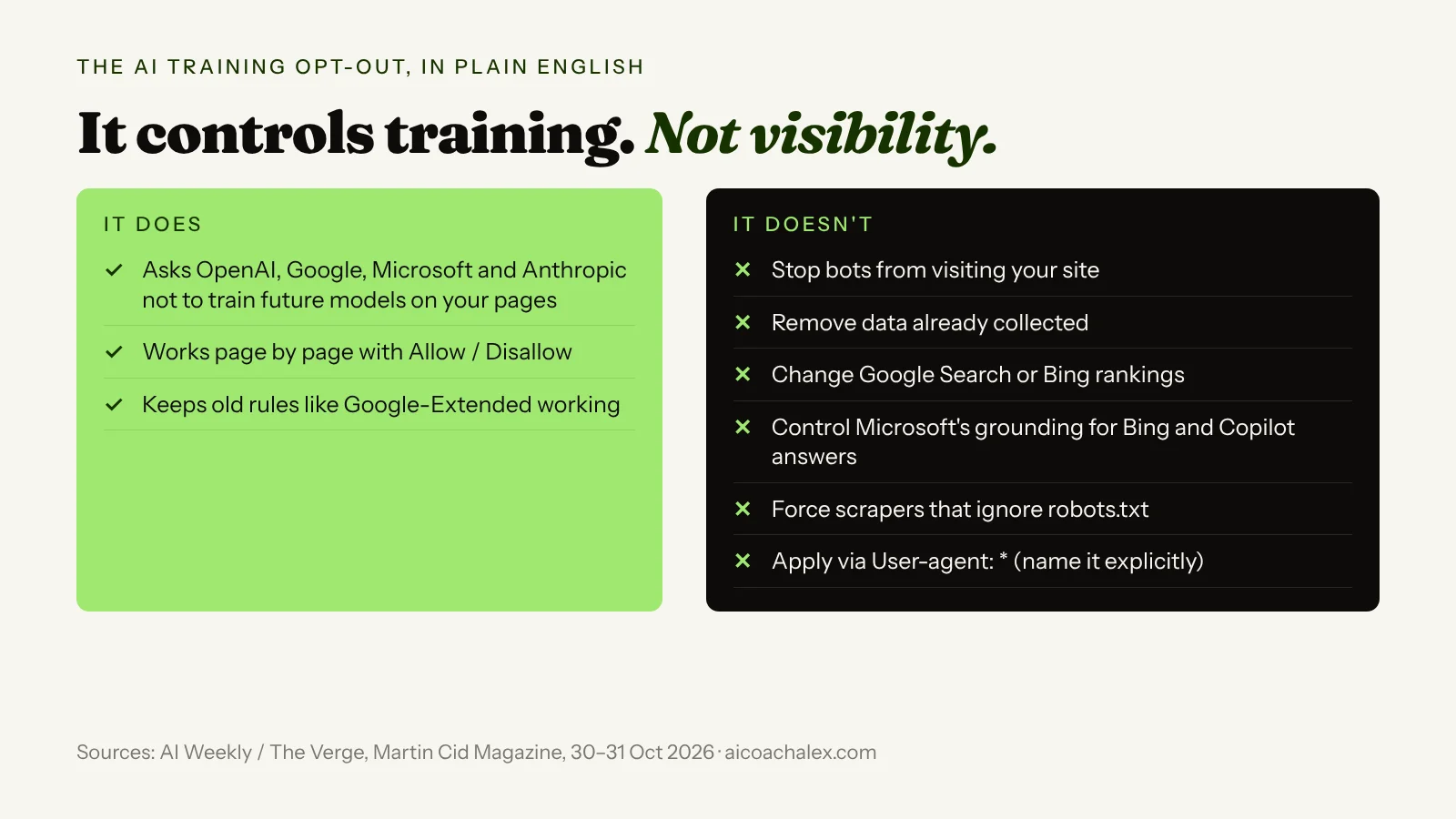
- Search is untouched. According to Martin Cid Magazine's breakdown, Google says Google-Extended doesn't affect Google Search, and Microsoft says its settings don't change whether you appear in Bing.
- AI answers are a separate switch. Microsoft has a separate "grounding" preference, set page by page with a meta tag or HTTP header, for content its AI pulls in to answer questions in Bing, Copilot and Microsoft 365. Microsoft warns that saying no there significantly reduces your visibility in those answers.
- The past stays in. Changing robots.txt doesn't remove content already collected into datasets or trained models. It only looks forward.
- It's a request, not a lock. OpenAI describes the token as "a coordination mechanism rather than a security control". Polite crawlers follow it. Bad scrapers don't.
Why it matters to you
For a small business, the real question isn't "can I stop AI?" It's "what do I want AI to know about me?"
If people ask ChatGPT, Claude or Gemini "who's a good accountant in Valencia?" or "best AI coach for small business", the models answer from what they learned in training and from pages they fetch live. A business that blocks training today might, over time, be known less well by the next generation of models. That's a real trade-off, and I wrote about the bigger picture in your next customer won't look at your website, it will read it.
On the other side, if your product is your content (courses, photography, paid newsletters, recipes, templates), training on it for free is a different matter. For you, this token is the first opt-out that works across all four big labs with one line.
My rule of thumb:
- You sell a service and want clients to find you: leave training on for your public marketing pages. Being known by AI is free marketing.
- You sell content: block training on the paid or premium parts, and keep your sales pages and "about" open.
- Either way: don't block search crawlers or AI answer features by accident while trying to block training.
How to set your AI training preference in robots.txt
- Look at what you have now. Type
yourdomain.com/robots.txtinto your browser. Note any lines mentioning GPTBot, ClaudeBot, Google-Extended orUser-agent: *withDisallow: /. Some site builders and security plugins added AI blocks without telling you. - Decide page by page, not site-wide. Write two lists: pages you want AI to know (home, services, about, pricing, FAQ, blog) and pages you'd rather keep out of training (paid content, client areas, downloads).
- Add the new group only if list two isn't empty. Use
User-Agent: __usage_ai-training, then aDisallow:line for each folder you want out of training, orDisallow: /for everything. Remember the wildcard group doesn't count. - Keep your old rules. Don't delete existing bot-specific lines during the changeover. Google and Microsoft won't follow the new token until 2027.
- Check nothing blocks search. Make sure there's no blanket
Disallow: /underUser-agent: *unless you truly want to vanish from search engines. - Set two reminders. 1 February 2027 (Microsoft starts honouring the token) and early 2027 to check Google's progress. If you use Wix, Squarespace, Shopify or WordPress and can't edit robots.txt directly, ask whoever manages your site.
Copy this prompt: your AI training policy in 10 minutes
Paste this into ChatGPT, Claude or Gemini with your current robots.txt. It helps you decide and writes the lines for you. Check the result before you publish it: a wrong Disallow line can hide your site from search.
You are a careful website advisor for a small business.
Help me decide which parts of my website AI companies may
use to train their models, and write the robots.txt lines.

MY BUSINESS: [e.g. physiotherapy clinic, online course creator]
HOW CLIENTS FIND ME: [e.g. Google, Instagram, referrals, ChatGPT]
WHAT I SELL: [service / content / products]
MY WEBSITE SECTIONS: [e.g. /services, /blog, /courses, /members]
MY CURRENT ROBOTS.TXT:
[paste it here]

Context: OpenAI, Google, Microsoft and Anthropic will honour
a shared robots.txt group "User-Agent: __usage_ai-training"
that only covers AI training. It doesn't affect search,
doesn't stop crawling, and "User-agent: *" doesn't cover it.

Then:
1. Ask me up to 5 questions if anything is unclear.
2. Recommend which sections to keep open to AI training and
   which to block, with one sentence of reasoning each.
3. Flag any existing line that might be hiding my site from
   search engines or AI answers by mistake.
4. Write the full updated robots.txt, keeping my old rules.
5. List what this will NOT protect, in plain English.

Mark anything you're unsure about as a guess.
A robots.txt nobody has read since the site launched. A security plugin quietly blocking some AI bots, missing others. No idea whether AI tools can see your services page.
A deliberate policy: marketing pages open so AI can recommend you, paid content out of training with one shared line, search untouched, and a reminder to recheck in 2027.
Want AI to recommend your business, not ignore it?
In a 49€ diagnostic call we check how ChatGPT, Claude and Gemini currently see your business, review what your website lets them read, and pick the first fixes to get you found.
Book a 49€ diagnostic →Also today in AI
Comcast cuts call-centre jobs as AI agents take over
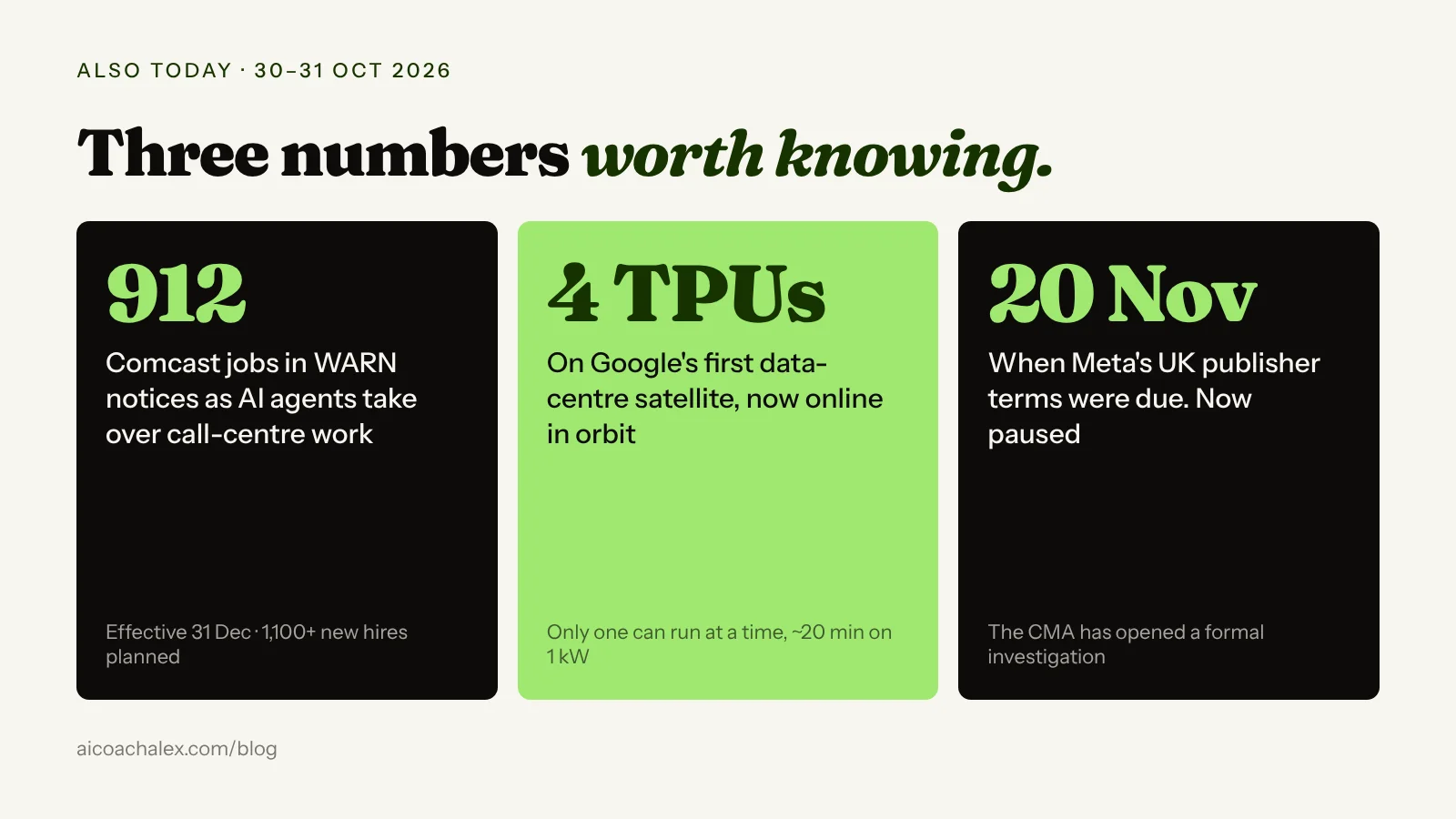
Comcast filed WARN notices for 912 jobs (634 in Philadelphia, 119 in New Jersey and 159 in Washington state), effective 31 December, while planning more than 1,100 new hires, according to AI Weekly. GadgetReview reports that Comcast, which lost 144,000 broadband customers last quarter, works with AI customer-service firms Cresta and Sierra, and that AI agents have removed more than 30 million service interactions this year and cut contact rates by roughly 20%.
What it means for you: if a giant can move a fifth of its customer contacts to AI, a small business can start with its top ten repeated questions. Write the answers once, put them on your site and in an assistant, and keep a human for the tricky ones. My post on companies rehiring the people AI replaced covers what goes wrong when you cut people first.
Google's first data-centre satellite is online
Google says its Project Suncatcher prototype, launched on a SpaceX Falcon 9 on 1 October, is now operational, and that its first test was Gemma 4 writing a haiku from orbit, as reported by AI Weekly. The satellite carries four TPUs but can power only one at a time, for about 20 minutes on a 1 kW budget. NewsBytes notes it is testing whether the chips survive radiation and extreme temperatures. Two more satellites with newer chips are planned for 2027.
What it means for you: nothing to do today. It's a signal of how hard AI companies are hunting for energy and computing power, which is why AI prices and usage limits keep shifting. Don't build your business on one tool's current price.
UK regulator investigates Meta's terms for publishers
The UK's Competition and Markets Authority opened a formal investigation on 30 October into whether Meta's updated commercial terms, which would let it use UK publishers' website content for its own products and AI features without a choice, abuse a dominant position, according to AI Weekly. Meta's revisions, due on 20 November, have been paused.
What it means for you: if you run ads or a business page on Facebook or Instagram, read the terms you accept. I unpacked what Meta's recent business terms mean for liability in Meta's new terms make you pay for its AI's mistakes.
FAQ
What is __usage_ai-training in robots.txt?
It's a shared robots.txt token that tells AI companies not to use your pages to train their models. You add it as its own group, "User-Agent: __usage_ai-training" followed by "Disallow: /" or specific folders. It comes from an IETF Internet-Draft written by Anthropic's Kevin Kelley in October 2026.
Which AI companies honour the new opt-out token?
OpenAI, Google, Microsoft and Anthropic. Anthropic has started rolling it out, OpenAI says in the coming months, Microsoft from 1 February 2027 and Google in 2027. Meta has welcomed the idea but hasn't committed to honour it.
Will blocking AI training hurt my Google ranking?
No. The token only covers AI training. Google says Google-Extended doesn't affect Google Search, and Microsoft says its training settings don't change Bing eligibility. Just don't add a blanket "Disallow: /" under "User-agent: *", which blocks search engines too.
Does the opt-out stop ChatGPT or Copilot from quoting my website?
Not by itself. It covers training, not live fetching to answer questions. Microsoft has a separate grounding preference, set with a meta tag or HTTP header, for its AI answers, and warns that opting out of grounding significantly reduces visibility in Bing and Copilot.
Does the opt-out remove content AI has already trained on?
No. It only applies going forward. Content already collected into datasets or trained models isn't removed when you change robots.txt.
Should a small business block AI training?
It depends on what you sell. If you sell a service and want to be recommended, keeping your public marketing pages open usually helps. If your content is the product, such as courses, photos or paid articles, blocking training on those sections makes sense. Decide page by page.
Get found by AI, on your terms.
One-to-one coaching for business owners: we decide what AI should know about your business, fix your website and listings, and set up AI tools that bring you clients.
Book a 49€ diagnostic → AI for Business OwnersSources: AI Weekly: OpenAI, Google, Microsoft, Anthropic back one AI opt-out token (30 Oct 2026, summarising The Verge); Martin Cid Magazine: One robots.txt line will opt your site out of AI training (31 Oct 2026); DEV Community, based on SiliconANGLE (31 Oct 2026); AI Weekly: AI news today (Comcast, Google Suncatcher, CMA and Meta, 30 Oct 2026); GadgetReview (Comcast, 26 Oct 2026); NewsBytes (Suncatcher). The rule of thumb and steps are my own advice.